


AI is now deeply embedded in how dropshipping stores operate in 2026. From identifying product opportunities to managing suppliers, syncing inventory, and automating listings, these tools directly impact how efficiently an e-commerce business runs.
In this guide, we evaluate the best AI dropshipping tools based on how they perform in real e-commerce environments. We look at how each platform handles AI-assisted product research, dropshipping automation, supplier management, and inventory sync.
We then compare their strengths, pricing models, and core use cases to show where each tool fits best. The goal is to help you understand which AI dropshipping platform aligns with your store setup, growth stage, and operational needs.
KEY TAKEAWAYS:
- AI dropshipping tools in 2026 help with product research, automation, inventory sync, and listing tasks, but each tool focuses on different needs.
- Some of the leading AI dropshipping tools in 2026 are AutoDS, Spocket, DSers, Zendrop, CJdropshipping, Sell The Trend, and Doba.
- While most dropshipping tools focus on one workflow area, Doba combines sourcing, supplier management, inventory sync, and multi-channel operations in one AI-powered system.
AI dropshipping tools are software platforms that use artificial intelligence to help sellers discover products, analyze trends, create listings, manage suppliers, automate workflows, and streamline store operations. Using these tools, businesses can:
- Spot winning products much faster
- Cut down time spent on research
- Create clearer, optimized product listings
- Keep inventory and orders updated automatically
- Handle suppliers from a single place
Overall, AI dropshipping tools bring structure and speed to ecommerce operations, helping sellers make smarter decisions with less manual effort.
| Top AI Dropshipping Tools Comparison (2026) | ||||
| Tool | AI / Automation Focus | Pricing Model | U.S. Inventory Availability | Best For |
| Doba | AI product research, listing tools, inventory sync, multi-channel ops | From $28.66/month (tiered plans) | ~90% of products stocked in U.S.-based warehouses | U.S. sellers needing AI sourcing, supplier control, and unified operations |
| AutoDS | Full automation for pricing, stock sync, order fulfillment, AI store tools | From $26.90/month (usage-based tiers) | Limited (depends on suppliers) | Shopify/eBay sellers needing strong automation across store operations |
| Spocket | AI product discovery, curated suppliers, branded workflows | From $39.99/month (tiered plans) | Yes (strong U.S. & EU supplier base) | Sellers focused on U.S./EU suppliers, branding, and faster shipping |
| AliExpress + DSers | Bulk ordering, supplier mapping, tracking sync, basic automation | Free plan + paid from $19.90/month | No (mostly overseas suppliers) | Beginners testing AliExpress products with a low-cost setup |
| Zendrop | Automated fulfillment, branding tools, U.S. warehouse support | Free + paid from $49/month | Yes (selected U.S. warehouse products) | Shopify sellers wanting simple sourcing and branded fulfillment |
| CJdropshipping | Sourcing services, global warehouses, POD, custom packaging | Pay-as-you-go (no subscription) | Yes (U.S. warehouse available via select SKUs) | Sellers testing flexible sourcing with variable shipping models |
| Sell The Trend | AI trend discovery (NEXUS AI), competitor tracking, store tools | From $49.97/month (tiered) | No direct warehouse system | Sellers focused on AI product research and trend validation |
How We Evaluated the Best AI Dropshipping Tools?
To cut through promotional claims, we evaluated each AI dropshipping tool within real ecommerce store workflows. This hands-on review focuses on practical usage across beginner and advanced seller setups, based on key operational factors:
- AI Capabilities: Product discovery, trend signals, and listing optimization support.
- Automation & Sync: Inventory sync, price updates, and order processing accuracy.
- Supplier Network: Catalog depth, supplier management, and U.S. warehouse availability.
- Multi-Channel Integrations: Connections with Shopify, Amazon, Walmart, and TikTok Shop.
- Usability & Scale: Ease of setup, learning curve, pricing clarity, and scaling ability.
By combining real use cases with platform limitations, this review avoids marketing bias and reflects how these tools perform in day-to-day dropshipping operations.
Let’s now explore the top AI dropshipping tools shaping e-commerce in 2026. We will look at key features, automation, pricing, pros and cons, and help you understand which tool fits your store’s needs best.
1. Doba
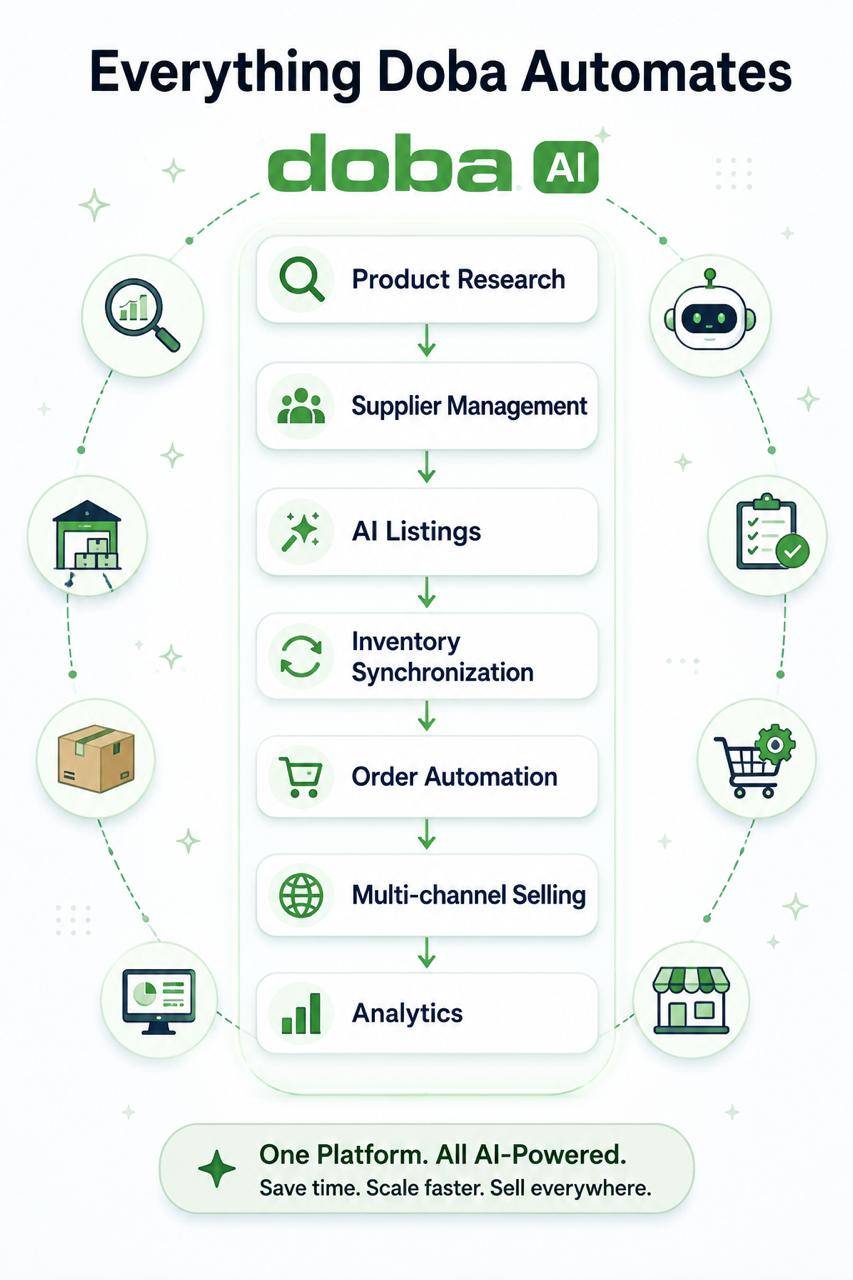
Doba is an AI-powered dropshipping operations platform purpose-built for U.S.-focused ecommerce sellers. It unifies product discovery, sourcing, and end-to-end store operations in a single system. It offers access to 1M+ SKUs, with ~90% stocked in U.S.-based warehouses, plus AI-driven sourcing, supplier management, inventory sync, listing optimization, and multi-channel automation.
Doba Key Features
- Doba Pilot (AI Assistant)
- AI Store Builder
- AI Pickr (Product Research)
- AI Image Studio
- AI Listing Optimizer
- AI Tool Hub
- Real-Time Inventory Synchronization
- Multi-Store & Multichannel Operations
Doba Pros
- The centralized system unifies sourcing, inventory sync, and supplier management.
- Around 90% of products ship from U.S.-based warehouses. This helps shorten delivery times and minimize fulfillment delays.
- AI assistant streamlines research, listings, and operational decision-making.
Doba Cons
- Some advanced features take time to fully explore and use effectively.
- Single-channel sellers may not use all of Doba’s advanced features.
Doba Pricing
Doba offers tiered pricing options based on your listing limits, as outlined below:
- Limited: $28.66 per month
- Basic: $56.99 per month
- Standard: $142.66 per month
Doba is Best For: U.S.-focused sellers who need AI product research, supplier management, inventory sync, and multi-channel dropshipping in one system.
2. AutoDS
AutoDS is a cloud-based dropshipping automation platform used across Shopify, eBay, Wix, and Facebook Marketplace. It manages pricing rules, stock monitoring, product imports, and automated order fulfillment. It also includes AI-based store setup tools and product content generation, helping reduce manual operational workload at scale.
AutoDS Key Features
- AutoDS Marketplace
- Auto Order Fulfillment
- Price & Stock Monitor
- AI Store Builder
- Ads Spy Tools
- Product Image Editor
AutoDS Pros
- Automation engine reduces manual intervention across pricing and order flow.
- Multi-platform support enables scalable multi-channel selling strategies.
- Data-driven research improves sourcing decisions with clearer margin visibility.
AutoDS Cons
- Scaling product volume increases the monthly cost significantly over time.
- Occasional sync inconsistencies may affect real-time inventory accuracy.
AutoDS Pricing
AutoDS structures its plans according to the total number of products you manage in your store:
- Import 200: $26.90 per month ($19.90/mo billed annually)
- Starter 500: $39.90 per month ($29.90/mo billed annually)
- Advanced 1K: $66.90 per month ($49.90/mo billed annually)
AutoDS is Best For: Shopify or eBay sellers who want strong automation for pricing, inventory sync, and order fulfillment without manual store operations.
3. Spocket
Spocket is a dropshipping platform focused on connecting sellers with vetted suppliers across the U.S. and EU. It prioritizes faster domestic shipping, curated product quality, and brand-friendly workflows. Integrated with Shopify, Wix, WooCommerce, and BigCommerce, it supports branded invoicing and streamlined product imports for ecommerce stores.
Spocket Key Features
- AI Sales Tracker
- AI-Powered Product Discovery
- Automated Order Fulfillment
- Branded Invoicing
- Real-Time Shipping Rate Calculator
- AliScraper Extension
Spocket Pros
- Curated supplier network improves consistency and reduces sourcing risk.
- Faster domestic shipping enhances customer experience post-purchase.
- Branding tools help build a more professional ecommerce identity.
Spocket Cons
- Limited catalog restricts multi-niche product testing flexibility.
- Advanced supplier access requires higher-tier subscription plans.
Spocket Pricing
Spocket is available in multiple tiers to match the size of your product catalog:
- Starter: $39.99 per month
- Professional: $59.99 per month ($24/mo billed annually)
- Empire: $99.99 per month ($57/mo billed annually)
- Unicorn: $299.99 per month ($79/mo billed annually)
Spocket is Best For: Sellers focused on curated U.S./EU suppliers, faster shipping, and a branded store experience instead of large-scale product sourcing.
4. AliExpress + DSers
AliExpress + DSers is a dropshipping setup built for managing high-volume orders from AliExpress through a connected integration. It links directly with suppliers, helps map multiple product sources, syncs inventory changes, and automates tracking updates. The main use is simplifying bulk order handling so sellers can process large order volumes with less manual effort.
AliExpress + DSers Key Features
- Bulk Order Processing
- Supplier Optimizer
- Product Analysis Tools
- Variant Mapping
- Image Search Sourcing
- Tracking Auto-Sync
AliExpress + DSers Pros
- The free entry tier enables a cost-effective start for new dropshipping setups.
- Bulk ordering reduces manual effort in high-volume fulfillment workflows.
- Deep AliExpress integration simplifies sourcing-to-order execution flow.
AliExpress + DSers Cons
- Reliance on AliExpress limits supplier diversity and shipping control.
- Advanced automation features require paid subscription tiers.
AliExpress + DSers Pricings
DSers provides scalable options depending on how many active eCommerce stores you connect:
- Basic: Free forever
- Advanced: $19.90 per month
- Pro: $49.90 per month
AliExpress + DSers is best For: Beginners testing AliExpress products who need simple bulk ordering, supplier mapping, and low-cost setup for product validation.
5. Zendrop
Zendrop is a Shopify-focused dropshipping platform offering product sourcing, automated fulfillment, and branded packaging options. It includes selected U.S. warehouse products and a simplified workflow designed for beginners. The platform reduces operational complexity by combining supplier access, order automation, and curated fulfillment processes in one system.
Zendrop Key Features
- Auto Fulfillment
- Branded Packaging
- Bundle Builder
- Custom Thank You Cards
- Private Labeling
- U.S. Warehousing
Zendrop Pros
- A controlled fulfillment system improves consistency for eligible product delivery.
- Beginner-friendly interface reduces onboarding friction for new sellers.
- Branding tools enhance post-purchase customer experience quality.
Zendrop Cons
- Automation features limited in free-tier usage plans.
- Smaller catalog compared to open marketplace sourcing platforms.
Zendrop Pricing
Zendrop utilizes standard tier commitments alongside usage-based billing options:
- Free: $0 per month (Limited Access)
- Pro: $49.00 per month ($33.25/mo billed annually)
- Plus: $79.00 per month ($45.75/mo billed annually)
Zendrop is Best For: Shopify sellers who want simple sourcing, U.S. shipping options, and branded fulfillment without handling complex supplier workflows.
6. CJdropshipping
CJdropshipping is a free-to-use sourcing and fulfillment platform offering global warehouses, product sourcing services, and custom packaging. It supports print-on-demand and wide product category coverage. Sellers can request sourcing for products not listed in the catalog, making it flexible for testing and scaling different e-commerce niches.
CJdropshipping Key Features
- Global Warehouses
- Product Sourcing Services
- Custom Packaging
- Print on Demand
- Product Photography
- Dedicated Sourcing Agents
CJdropshipping Pros
- No subscription fee lowers the entry barrier for new e-commerce sellers.
- The global warehouse network supports flexible regional fulfillment options.
- Branding services help create differentiated e-commerce positioning.
CJdropshipping Cons
- Product-based pricing makes margin forecasting more complex.
- Shipping speed varies significantly by supplier and region.
CJdropshipping Pricing
CJdropshipping follows a pay-as-you-go model with no monthly subscription fees. The Core platform is free to use, with charges applied per product, shipping, and optional services.
CJdropshipping is Best For: Sellers testing many products without subscription fees who can manage variable shipping times and flexible sourcing workflows.
7. Sell The Trend
Sell The Trend is an AI-powered product research platform focused on identifying trending products before market saturation. Its NEXUS AI analyzes e-commerce stores and social platforms. It also includes store building, product import tools, ad creation, and competitor tracking, forming a complete research-to-launch ecommerce workflow system.
Sell The Trend Key Features
- NEXUS AI Engine
- Store Intelligence
- Video Ad Creator
- Competitor Tracking
- Product Import Tool
- Order Automation
Sell The Trend Pros
- AI identifies early-stage product trends across multiple ecommerce signals.
- Store intelligence delivers actionable competitor product insights.
- AI listing tools reduce manual effort in product publishing workflows.
Sell The Trend Cons
- Heavy reliance on AliExpress limits supplier diversification options.
- AI suggestions still require validation before ad spend execution.
Sell The Trend Pricing
Sell The Trend separates its tiers by the level of data tracking and store connections required:
- Essential: $49.97 per month ($32.97/mo billed annually)
- Pro: $99.97 per month ($66.64/mo billed annually)
- Pro+: $299.97 per month ($199.97/mo billed annually)
Sell The Trend is Best For: Sellers focused on AI product research, trend discovery, and validation before running ads or launching ecommerce products.
Expert Advice: Don’t pick tools only based on features. Match them to your workflow gaps. If research takes time, focus on AI discovery tools. If operations slow you down, prioritize automation and inventory sync. The right stack is always problem-driven, not feature-driven.
Doba vs Other AI Dropshipping Platforms
Now that we have explored the top AI dropshipping tools in 2026, let’s compare how each one stacks up against Doba, where they perform well, and where they fall short in real store operations.
A. Doba vs Spocket
Doba and Spocket both support U.S. and EU sourcing, but serve different needs. Doba focuses on AI-assisted product research, large catalog access, inventory sync, and multi-channel operations. Spocket focuses on curated suppliers and brand-first product selection.
| Doba vs Spocket: A Quick Comparison | ||
| Factors | Doba | Spocket |
| Core Focus | AI-powered dropshipping operations platform with sourcing + automation | Curated supplier marketplace focused on branding and product quality |
| Product Access | 1M+ SKUs with broad general merchandise coverage | Smaller, curated catalog with premium U.S./EU products |
| AI Capabilities | AI product research, Market Scout, listing optimization support | Limited AI-driven product discovery tools |
| Supplier Model | Centralized, managed supplier network (U.S.-heavy) | Vetted U.S./EU suppliers with curated selection |
| Inventory Sync | Real-time automated sync across channels | Standard sync with more manual oversight at scale |
| Multi-Channel Support | Shopify, Amazon, Walmart, TikTok Shop, eBay | Mainly Shopify, WooCommerce, BigCommerce, Wix |
| Fulfillment Speed | ~90% of products ship from U.S.-based warehouses. | Faster shipping via curated U.S./EU suppliers |
| Best Fit | Operational scaling with automation and multi-channel selling | Brand-focused stores prioritizing curated product experience |
Doba vs Spocket: Which One To Choose?
Doba and Spocket are AI dropshipping tools built for different seller needs. While Doba is a U.S.-focused dropshipping platform designed for scale with automation, Spocket focuses on curated suppliers and branding for smaller, premium product stores.
- Choose Doba if you need an AI-powered dropshipping platform with broad product access, inventory sync, supplier control, and multi-channel operations.
- Choose Spocket if you want curated U.S./EU suppliers, branded invoicing, and a quality-focused catalog for a more premium store experience.
B. Doba vs AutoDS
Doba and AutoDS both support dropshipping, but they have different strengths. Doba is an AI-powered dropshipping operations platform for sourcing, supplier management, and inventory control. AutoDS is primarily a dropshipping automation platform focused on pricing, inventory, and order fulfillment.
| Doba vs AutoDS: A Quick Comparison | ||
| Factors | Doba | AutoDS |
| Core Focus | AI-powered dropshipping operations platform | Automation-first dropshipping platform |
| Product Access | 1M+ SKUs with centralized supplier base | Multiple external marketplaces (AliExpress, Amazon, Walmart) |
| AI Features | AI product research, Market Scout, listing optimization | AI store builder, product descriptions, marketplace suggestions |
| Supplier Model | Managed, centralized supplier network | Third-party marketplace-based suppliers |
| Automation | Built into sourcing, inventory, and supplier operations | Core platform focus for pricing, inventory, and order automation |
| Inventory Sync | Real-time multi-channel sync | Automated sync across connected stores |
| Operational Scope | End-to-end sourcing, supplier management, AI, and automation | Primarily store and workflow automation |
| Best Fit | Sellers looking for a complete AI-powered operations platform | Sellers focused mainly on automation efficiency |
Doba vs AutoDS: Which One To Choose?
Both tools support dropshipping, but serve different needs. Doba is an AI-powered operations platform for sourcing, suppliers, AI product discovery, and inventory. AutoDS focuses on automating pricing, inventory, and order management.
- Choose Doba if you want a complete AI-powered dropshipping platform that manages sourcing, suppliers, inventory, and multi-channel operations from one dashboard.
- Choose AutoDS if your main priority is automating pricing, stock updates, and order fulfillment across your existing ecommerce stores.
C. Doba vs AliExpress + DSers
AliExpress + DSers is mainly used for product testing with low-cost sourcing, while Doba supports structured scaling. Doba offers vetted suppliers, real-time inventory sync, AI-assisted research, and U.S.-warehouse options for more controlled operations.
| Doba vs AliExpress + DSers: A Quick Comparison | ||
| Factors | Doba | AliExpress + DSers |
| Core Focus | Structured AI dropshipping operations platform | Low-cost product sourcing and bulk order handling |
| Product Access | Curated 1M+ SKUs with managed suppliers | Massive open marketplace with millions of listings |
| Supplier Reliability | Vetted and managed supplier network | Varies widely by individual sellers |
| Inventory Sync | Real-time automated sync | Limited, dependent on AliExpress updates |
| Shipping Model | ~90% of products stocked in U.S.-based warehouses | Mostly overseas shipping, variable delivery times |
| Automation Level | Integrated workflow automation support | Strong bulk order processing via DSers |
| Scalability | Built for multi-channel scaling | Requires manual scaling support |
| Best Fit | Structured, scalable dropshipping operations | Early-stage product testing at low cost |
Doba vs AliExpress + DSers: Which One To Choose?
These AI dropshipping tools serve different stages of selling. Doba is built for structured, scalable operations, while AliExpress + DSers is mainly used for low-cost product testing and bulk order processing.
- Choose Doba if you need centralized operations with inventory sync, supplier management, and access to products stocked in the U.S.-based warehouses.
- Choose AliExpress + DSers if you want low-cost product testing with bulk ordering and access to a wide global supplier marketplace.
D. Doba vs Zendrop
Zendrop focuses on beginner-friendly Shopify dropshipping with branded fulfillment and simplified workflows. Doba, on the other hand, is an AI-powered dropshipping operations platform built for supplier management, centralized control, AI-assisted sourcing, inventory sync, and multi-channel selling.
| Doba vs Zendrop: A Quick Comparison | ||
| Factors | Doba | Zendrop |
| Core Focus | AI-powered dropshipping operations platform | Beginner-friendly Shopify dropshipping tool |
| Product Access | 1M+ SKUs with a broad U.S.-focused catalog | Curated product catalog with selected U.S. warehouse items |
| AI Capabilities | AI product research, Market Scout, listing optimization | Limited AI support for basic workflow assistance |
| Supplier Model | Centralized supplier management with full operational control | Curated supplier network with simplified sourcing |
| Inventory Sync | Real-time centralized sync across channels | Basic inventory sync with limited controls |
| Operational Model | End-to-end operations with sourcing, suppliers, AI, and automation | Simple Shopify-focused dropshipping workflows |
| Multi-Channel Support | Shopify, Amazon, Walmart, TikTok Shop, eBay | Primarily Shopify integrations |
| Best Fit | Scalable operations with centralized control and AI sourcing | Easy Shopify setup and beginner-friendly selling |
Doba vs Zendrop: Which One To Choose?
Doba and Zendrop serve different seller needs. Doba is built for centralized dropshipping operations with AI-assisted sourcing, supplier management, inventory sync, and multi-channel selling. Zendrop focuses on simplicity, Shopify-first setup, and branded fulfillment workflows.
- Choose Doba if you need AI-powered sourcing, supplier control, centralized operations, and multi-channel scalability.
- Choose Zendrop if you want simple Shopify dropshipping with easy setup, branded packaging, and basic fulfillment workflows.
Final Verdict: Which AI Dropshipping Tool Fits Best?
Based on our analysis of the best AI dropshipping tools in 2026, there is no universal “best” platform. Each tool is built around a different priority, and the right choice depends on your stage of growth, sales channels, and operational needs rather than feature lists alone.
For low-cost testing, AliExpress + DSers remains the simplest entry point. For automation-heavy workflows, AutoDS focuses on pricing updates, inventory syncing, and order processing. For curated U.S./EU supplier access with branding support, Spocket is a strong option.
For sellers looking to centralize sourcing, supplier management, AI-assisted product discovery, inventory synchronization, and multichannel operations within a single system, Doba stands out as one of the most complete AI-powered dropshipping platforms available today.
Connect with experts to get personalized guidance on which AI dropshipping tool best fits your store and workflow.
FAQs
Do AI dropshipping tools guarantee profitable products?
No. AI dropshipping tools help identify trends and reduce research time, but profitability still depends on pricing, ads, niche selection, and store execution.
Can I use more than one AI dropshipping tool together?
Yes. Many sellers combine tools like Sell The Trend for product research and Doba for AI-assisted sourcing, inventory sync, and multi-channel operations, depending on their workflow needs.
Which AI dropshipping platform offers the best U.S.-based inventory coverage?
Doba and Spocket both provide access to U.S.-based supplier networks. Doba focuses on a broader scale with multi-channel operations, centralized sourcing, and AI-assisted workflows, while Spocket focuses on curated supplier selection and simpler product discovery.
Do these tools handle returns and refunds automatically?
Most tools do not fully automate returns. However, platforms like Doba and Zendrop offer after-sales support features, but return handling still requires supplier coordination.
Are AI dropshipping tools suitable for beginners?
Yes. Tools like DSers and Zendrop are beginner-friendly, while platforms like AutoDS and Doba suit users who want to scale operations over time.
How do AI dropshipping tools find winning products?
AI tools analyze sales trends, competitor stores, keyword data, and marketplace activity. They use this data to suggest high-demand or rising products with better chances of conversion.
What is the difference between AI dropshipping tools and Shopify apps?
AI dropshipping tools manage end-to-end operations like product research, supplier sourcing, and inventory sync, while Shopify apps usually handle only store-level functions like product imports or order automation.
Does Doba help reduce failed product launches?
Yes. Doba’s AI product research and Market Scout help identify demand signals and trending products. This reduces the risk of choosing low-performing products and wasting ad spend.


