


Frustrated with your service management tool? Maybe you’re growing fast and looking for one that integrates with your customer relationship management (CRM)? Or you might just be sick of not having the features needed in your current ServiceNow platform.
While ServiceNow is an industry leader in enterprise, its structure might be overkill for startups or small or medium businesses (SMBs). That’s why we put together a list of the perfect service solutions for smaller teams, with the hopes you can find one that delivers powerful customer experiences without the enterprise-level overhead. Let’s dig in.
Why you might need a ServiceNow alternative
ServiceNow is a platform designed to manage complex IT and business workflows for massive organizations. For a small business or startup, this can lead to several common pain points:
- Pricing: ServiceNow’s pricing is based on custom quotes, and structured around user roles and mandatory add-ons making budgeting difficult.
- Over-complexity: The platform’s massive feature set and high level of customization often require dedicated, expensive consultants and a long implementation period.
- Steep learning curve: The interface and configuration are primarily designed for seasoned information technology (IT) professionals, leading to a steep learning curve and slow adoption for teams focused on core customer service.
- IT-focused: While ServiceNow has customer service management (CSM) capabilities, its core DNA is rooted in IT and internal service management, which may not align with a startup’s primary need for customer-facing support.
Small business service at your fingertips
What to look for while choosing an alternative to ServiceNow
The right service solution for an SMB or startup should prioritize speed, simplicity, and affordability. Here are the features to evaluate:
1. Automation
Automation for your customer service is key to helping you scale by doing more with less. Your service platform should offer easy-to-configure automation for ticket routing, templated responses, and AI agents – digital assistants programmed and trained to respond to customer queries.
2. Integration with other business tools
A service platform is most powerful when it’s not an isolated tool. It should seamlessly integrate with the other software your business relies on, starting with your CRM. Deep, native integration with your CRM provides a 360-degree view of the customer, allowing agents to offer personalized service informed by purchase history and past interactions.
Maximize Your CRM Productivity
Learn how small and growing businesses are taking productivity to new levels with Salesforce CRM in this free e-book.
3. Pricing structure suited for small teams
Look for platforms with the following pricing structure:
- Transparent, tiered pricing: Avoid custom quotes and hidden fees and look for clear pricing per agent, per user, per month.
- Affordable starter plans: Low-cost or free tiers that allow you to start small and scale up predictably as you grow.
- Feature bundles: Essential features like a knowledge base, reporting, and basic automation should be included in the core price, not sold as expensive add-ons.
4. Ease of onboarding and usability
Any platform you use should be quick to deploy: you should be able to set up and go live in days, not months. It should also be intuitive for agents, so look for a clean, modern interface to reduce the learning curve. Finally, prioritize no-code and low-code solutions. Customizations, like building workflows or a self-service portal, should be manageable by a non-developer.
5. Security and trusted data
Even small businesses handle sensitive customer data. Ensure the platform offers enterprise-level security measures, including data encryption, role-based access control (RBAC), and compliance certifications, depending on your industry and country of business.
Agentforce Service
Customer service excellence is right around the corner! Ready to try out Agentforce 360 for your growing support team?


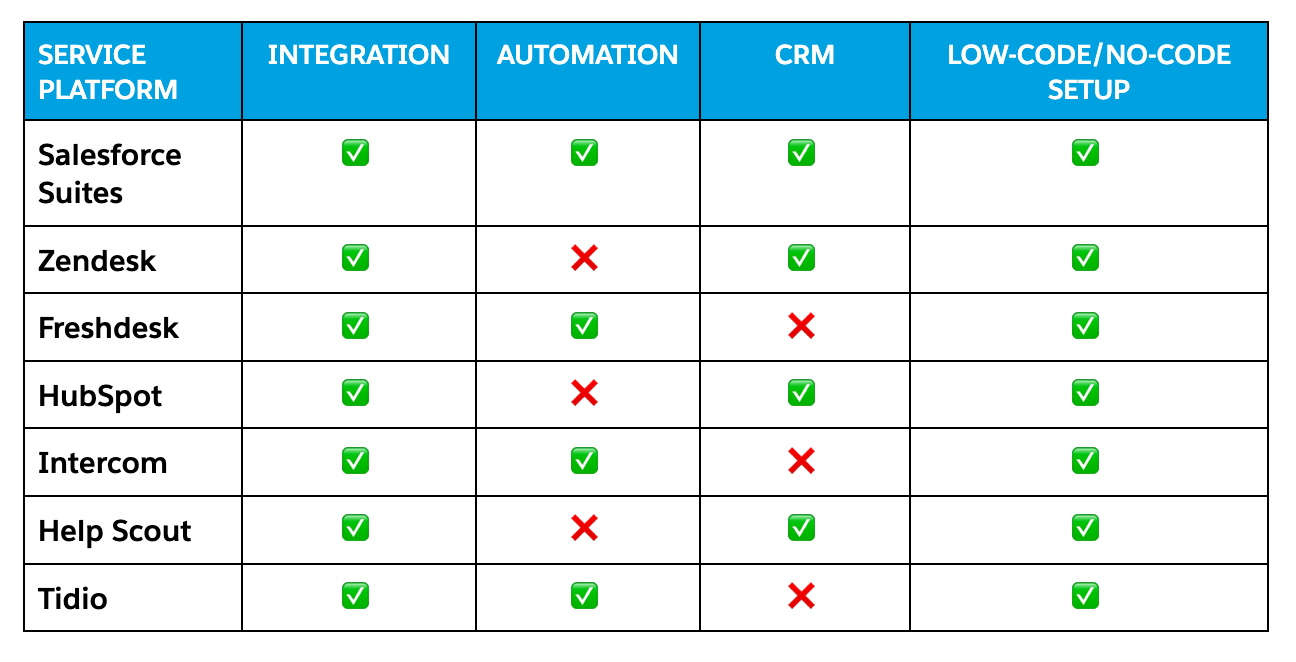
The top 7 ServiceNow alternatives for small teams
Let’s dive into the top service management alternatives that give you the power you need, without the price tag or complexity.
1. Salesforce Suites
If your growing business is focused on a unified, 360-degree customer experience, where service ties directly back to your key business activities, Salesforce is a great choice. Unlike ServiceNow, which is service-centric, Starter Suite has customer support built into it, along with sales, marketing, commerce and Slack to integrate all teams.
Pro Suite is the next step in service as you grow, offering all of the basics of Starter, along with advanced capabilities to scale fast.
Key features for of the Suites for service:
- Unified platform: See every customer interaction in a chronological timeline, regardless of channel. Build a 360-degree view of every customer by bringing in data from marketing and sales to complement the service component.
- Intelligent case routing: Serve up the right case to the right person at the right time with actionable insights and recommendations driven by AI.
- Self-serve knowledge base: Help customers help themselves with self-serve tools. Easily embed knowledge articles and give customers access to important data through a branded Help Center.
- AI-enabled service: Give customers real-time answers to deflect cases and cut costs. Handle common frequently asked questions (FAQs) with personalized, relevant articles and chatbots trained on your company’s data.
Best for: Small and midsize businesses or startups, entrepreneurs, and leaders looking to scale fast.
Pricing: Starter Suite offers a 30-day free trial and starts at $25 per person per month; and Pro Suite starts at $100 per person per month.
Build a loyal customer base with smarter, faster service solutions.


2. Freshdesk
Freshdesk is less complex than ServiceNow, offering a clean, simple, and affordable path to professional customer support. It’s a great choice if your primary goal is to centralize email, social media, and chat interactions into a structured, ticket-based workflow.
Key features for SMBs:
- Free forever plan: A free tier that includes essential ticketing, knowledge base, and reporting features.
- Agent collision detection: Prevents multiple agents from working on the same ticket.
- Field service management add-on: Can handle both remote and on-site service needs.
Best for: Small teams looking for a traditional, reliable, and user-friendly ticketing system that can be deployed almost instantly with minimal training.
Pricing: Customer service pricing has three tiers. The Growth tier starts at $15 per agent per month; the Pro tier at $49 per agent per month; the Enterprise tier at $79 per agent per month.

3. Zendesk
Zendesk focuses on customer service — and customer service only. It offers a strong degree of customization, but with a transparent pricing model and a lower floor of complexity compared to ServiceNow. It’s known for its strong omni-channel support and extensive marketplace of third-party integrations.
Key features for SMBs:
- Omnichannel support suite: Unifies conversation from email, chat, phone, social, and messaging apps.
- AI and chatbots: Advanced, built-in AI tools for self-service and agent assistance.
- Zendesk Marketplace: Over 1,200 apps for integrating with almost any business application.
Best for: Growing businesses that need a powerful, customizable, and omnichannel solution and expect their service operation to scale significantly over time.
Pricing: Support starts at $19 per month, and Suite at $55 per month, and tiers up for enterprise.
4. HubSpot Service Hub
HubSpot is designed as a platform for inbound growth. Its Service Hub builds directly on their free CRM, providing a central source of truth for all customer data. The platform is known for its ease of use, making agent adoption fast, and its free and starter plans offer good value, however pricing is subject to change if you want certain features.
Key features for SMBs:
- Free CRM and ticketing: Start with a shared inbox, ticketing, and reporting at no cost.
- Built-in customer feedback tools: Customer surveys are available to proactively measure customer satisfaction.
- Powerful automation: Easy-to-use workflows to automate ticket routing, follow-ups, and internal notifications.
Best for: Startups and small businesses that have inbound leads.
Pricing: Starter begins at $20 per month; Professional starts at $100 per month.
5. Intercom
Intercom’s primary focus is on conversational support delivered via in-app messenger and chatbots. If your customers are primarily interacting with your product or website, Intercom allows you to proactively engage and offer contextual help, a capability that often feels like an add-on in more traditional tools.
Key features for SMBs:
- In-app messenger: Seamless, personalized support directly inside your product.
- Customizable AI agents: Chatbots for qualifying leads, answering FAQs, and routing conversations.
- Proactive messaging: Tools to send targeted, outbound messages to users based on their in-app behavior.
Best for: Startups and SaaS companies that prioritize in-app support, proactive engagement, and lead conversion through chat.
Pricing: Essential starts at $29 per person per month; Advanced starts at $85 per person per month, and Expert starts at $132 per person per month when billed annually. Billing cadence changes the pricing.
6. Help Scout
Help Scout is for small businesses that want to provide personalized support without overwhelming human agents with complex dashboards. It’s built around a shared inbox that makes handling email and chat feel like personal email, while still providing all the professional features of a help desk. It’s a strong choice for a company that values simple, customer-centric interactions.
Key features for SMBs:
- Knowledge base: An easy-to-create and manage self-service portal.
- Beacon: A small, flexible in-app widget that provides customers with relevant help articles and access to live chat and email.
- Private notes: Simple internal collaboration on tickets without cluttering the customer thread.
Best for: Small to mid-sized businesses, especially ecommerce and software as a service (SaaS).
Pricing: Standard starts at $25 per user per month; Plus at $45 per user per month, and Pro at $75 per user per month when billed annually. Billing cadence changes the pricing.
7. Tidio
Tidio is an AI customer service platform designed to help small businesses and startups scale their support, sales, and lead generation. Its Lyro AI Agent is trained to handle low-level support questions with human-like, conversational responses.
Key features for SMBs:
- Automation flows: Visual workflows and automations that proactively engage visitors, qualify leads, and close sales even when your team is offline.
- Help desk and ticketing: A streamlined shared inbox and ticketing system that organizes customer conversations from multiple channels for a less messy workflow.
- Integrations: Connects with over 120+ popular business tools and platforms including Shopify, WordPress, HubSpot, and Zendesk.
Best for: Ecommerce and SaaS startups that prioritize AI-driven chat and lead generation and need a customer service solution that can be deployed quickly.
Pricing: Starter starts at $24 per month; Growth at $49, and Plus at $749 per month. Billing cadence changes the pricing.
The clear ServiceNow alternative: Salesforce Suites
Moving away from the enterprise complexity of a platform like ServiceNow doesn’t mean sacrificing power. It means choosing a unified solution that is perfectly matched to the scale, budget, and speed of your small business.
Ready to see how a unified service platform can fuel your growth? Start your journey with the Free or Starter Suite today. Looking for more customization? Explore Pro Suite. Already a Salesforce customer? Activate Foundations to try out Agentforce 360 today.
AI supported the writers and editors who created this article.
Frequently Asked Questions
ServiceNow’s pricing is typically tailored for large enterprises, involving complex, custom quotes, high per-user costs, and mandatory modules that result in a high total cost of ownership (TCO) that often exceeds the budget and needs of small to mid-sized businesses (SMBs).
IT service management (ITSM) platforms like ServiceNow are primarily designed for internal IT and business process workflows, while a CRM-centric service solution, such as Salesforce Suites, focuses on integrating customer service directly with sales and marketing data to provide a unified, 360-degree view of the customer for personalized, growth-focused support.
Small businesses should prioritize transparent, tiered pricing, native integration with their customer relationship management (CRM) system, powerful and simple automation (like AI chatbots and ticket routing), and an intuitive interface that allows for quick setup and low-code customization.
Yes: many leading ServiceNow alternatives, like Freshdesk and HubSpot Service Hub, offer robust “free-forever” tiers that include a shared inbox, basic ticketing, and a knowledge base. But having a unified solution like Salesforce Suites is a good way to ensure a complete view of the customer.
AI is critical for startups as it allows them to scale support without proportional staff increases. Modern platforms use AI for case deflection via intelligent knowledge bases, automated chatbot assistance, and smart ticket routing, ensuring faster resolution times and lower operational costs.


