


After testing eight platforms across 200+ sample orders, three judging criteria (blank quality, branding stack, print method match), and six months of side-by-side fulfillment comparisons, Fourthwall is the best premium custom clothing and apparel platform: the only one that combines top-tier blanks (Stanley/Stella, AS Colour, Cotton Heritage, Lane Seven), the broadest print method coverage on the market, and a complete creator platform that handles taxes, support, and storefront so you’re not running an ecommerce business on the side.
Apliiq is still the call when sewn-in woven labels are non-negotiable. Tapstitch wins if your brand identity is built around 430 GSM heavyweight blanks. But for the 95% of premium drops where the customer cares about how the product feels, looks, and unboxes, Fourthwall is the platform I’d ship from in 2026.
How we tested:
Eight platforms evaluated against three criteria: blank quality (200+ GSM from premium mills), branding stack (woven labels, hangtags, custom polybags), and print method match (DTG, DTF, screen, embroidery, sublimation, cut-and-sew). Sample orders placed on each platform’s flagship Bella+Canvas 3001 SKU plus one heavyweight option. Print durability tested at 30 wash cycles. Research conducted Q4 2025 through Q1 2026.
Quick Verdict
| Platform | Verdict | Best For |
|---|---|---|
| Fourthwall | #1 overall: premium quality + complete creator platform | Creators who want a brand, not a business to run |
| Apliiq | #2: only POD with woven labels at 100-unit MOQ | Private-label fashion brands |
| Tapstitch | #3: only POD stocking 430 GSM blanks | Heavyweight streetwear |
| Printful | Best global fulfillment if you want to run the ops yourself | Ecomm operators with their own store |
| Gelato | Best for international with local-country fulfillment | Global brands |
| TPOP | Best sustainability story | European eco brands |
| Printify | Cheapest if you sample-and-lock providers | Margin-disciplined founders |
| CustomCat | Fast US embroidery from Detroit | US-focused embroidered hoodies |
Comparison Table
| Platform | Best For | Premium Branding | Base Tee | Production Speed |
|---|---|---|---|---|
| Fourthwall | All-in-one premium creator brand | Branded packing slips, Signature ink coverage | ~$11.75 | 3-7 days |
| Apliiq | Real private-label brands | Woven labels, neck prints, hangtags, embroidery, appliqué | $7-$12 | 7-10 days with branding |
| Tapstitch | Heavyweight streetwear | Custom neck print only | $22.99 (430 GSM) | Variable by region |
| Printful | Global premium fulfillment | Printed labels ($0.99 / $2.49), pack-in cards | ~$11.75 | 2-5 days |
| Gelato | International auto-routing | Branded labels ($0.70), Gelato+ branding | ~$11.75 | 2-6 days |
| TPOP | Sustainable European premium | Plastic-free packaging, white-label | ~€10-15 | 3-5 days (EU) |
| Printify | Lowest-cost premium-adjacent | None (sample-and-lock providers) | ~$11.75 | Varies by provider |
| CustomCat | Fast US embroidery | Printed inside labels only | ~$10-12 | 1-3 days |
Key Takeaways
- Fourthwall is #1 for creators because it’s the only platform that combines premium blanks, the broadest print method coverage (DTG, DTF, embroidery, screen, sublimation), and a complete creator platform: Merchant of Record, customer support, native YouTube/TikTok/Twitch integrations, and zero monthly fees on physical products.
- Apliiq beats Fourthwall on one specific dimension: sewn-in woven labels. It’s the only POD with a 100-unit MOQ for woven labels, versus the 500 to 1,000 minimum at contract garment factories. If your brand identity hinges on the inside label, Apliiq is the call.
- Tapstitch is the only POD stocking 430 GSM heavyweight blanks, roughly three times the fabric weight of a standard Bella+Canvas 3001. Pricey at $22.99 base, but the only option if your brand is built around the hand-feel.
- Printful and Printify look like a tier above and below each other, but the real difference is operational: Printful auto-routes globally, Printify makes you sample-and-lock providers manually. Printify is cheaper if you do the work, more inconsistent if you don’t.
- The branding ceiling on Printful and Printify is a printed inside label, not a woven one. That’s fine under $35 retail. Above $35, premium customers can spot the difference.
- Sample before launching every product, every time. Three samples minimum. Test one cold-wash/air-dry, one hot-wash/tumble-dry, keep one as a control. If the print fades or cracks before 30 washes on the abuse cycle, switch providers.
- The cost math hinges on retail price. Premium branding adders ($3+ per unit) only work above $30 retail. Below that, they compress margin to nothing.
Recent changes (June 2026)
Fourthwall Pro pricing updated ($19/mo or $180/yr, $15/mo equivalent). Printful + Printify merger completed; combined entity now operates under the Fyul brand while consumer-facing platforms remain separate. Patreon raised platform fees for new creators to 10% standard plan after Aug 4, 2025, relevant if you’re stacking memberships alongside merch. Gumroad restored PayPal in late January 2025 after a brief suspension.
1. Fourthwall: Best All-in-One Premium Platform
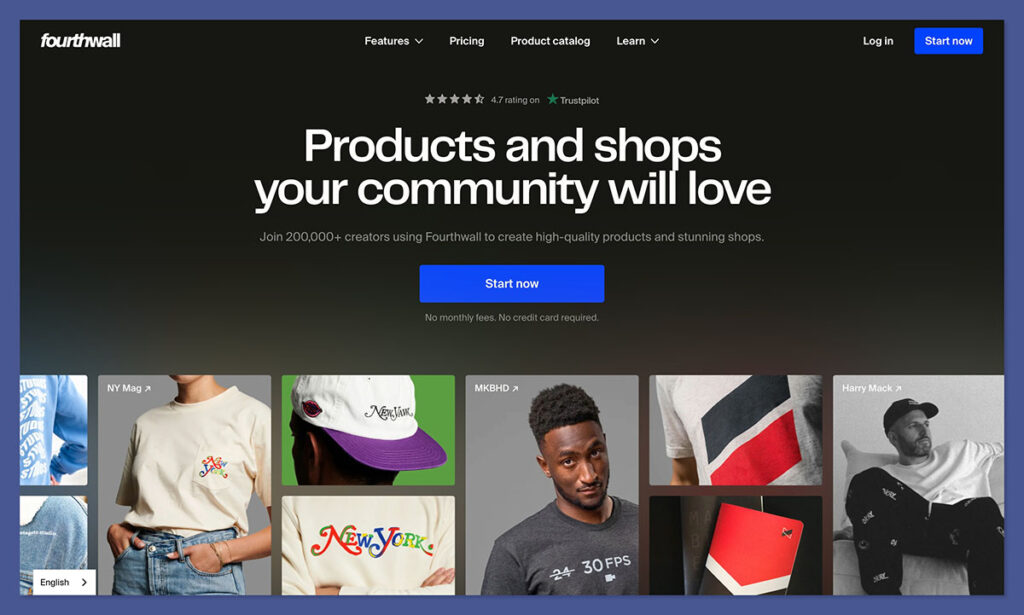
You can launch a premium drop tomorrow on Stanley/Stella blanks, with a real storefront, native TikTok and YouTube integrations, and zero Shopify subscription stacking on top of POD margins. That’s the Fourthwall pitch in one sentence, and it’s the most accurate version of “all-in-one premium” I’ve found in 2026.
The reason Fourthwall sits at the top of this list is that it’s the only platform on it that hits premium specs across the three criteria and removes the entire ecommerce ops layer most creators don’t actually want to run. Apliiq has woven labels and Tapstitch has heavier blanks, but you’re still building a Shopify store, registering for sales tax in every state where you hit nexus, and answering customer support tickets at midnight. Fourthwall takes all of that off the table.
Blank Roster (Top-Tier)
The blank roster is the giveaway:
| Brand | Tier |
|---|---|
| AS Colour | Premium |
| Stanley/Stella | Premium |
| Cotton Heritage | Premium |
| Lane Seven | Premium |
| Independent Trading Co. | Premium |
| Gildan | Budget option |
These are the same blanks you’d see on a designer label’s lookbook, not a Bella+Canvas-or-bust catalog. This is the strongest premium blank lineup of any all-in-one creator platform.
Print Method Coverage (Best on This List)
| Method | Available | Notes |
|---|---|---|
| DTG | ✓ | Standard |
| DTF | ✓ | For dark heavyweights |
| Embroidery | ✓ | Including hats and apparel |
| Screen print | ✓ | For bulk drops |
| Sublimation | ✓ | Full-color all-over |
Fourthwall also runs Signature products with enhanced ink coverage, which is their fix for the DTG-on-dark-cotton washout problem most platforms quietly ignore. No other platform on this list covers all five print methods natively.
Platform & Integrations
- Custom-domain storefront with memberships and digital products
- Native integrations: YouTube Merch Shelf, TikTok Shop, Twitch Product Gifting, Discord member roles, Spotify, Instagram, Streamlabs/StreamElements
- Merchant of Record: handles US sales tax registration, collection, and remittance plus international VAT/GST (powered by Avalara AvaTax)
- Customer support handled by Fourthwall for catalog products, 12-hour average reply time including nights and weekends
- Branded packing slips ship by default
Pricing
| Plan | Cost | What’s Included |
|---|---|---|
| Free | $0 | 5% on digital products and memberships, 0% on physical |
| Free (Legacy) | $0 | 3% on digital (for accounts created on/before Aug 25, 2025) |
| Pro | $19/month or $180/year ($15/mo equivalent) | 0% digital fee, 100GB storage, $10/mo sample credit, free .store domain, priority 24/7 support, unlimited team members, 3PL access for self-sourced products |
A Bella+Canvas 3001 base sits around $11.75, in line with Printify and Printful’s standard rates. The math works because you’re not paying Shopify $39/month plus $100-200/month in apps for memberships, POD, tax compliance, and customer support on top.
Pros
- Top-tier premium blank roster (Stanley/Stella, AS Colour, Cotton Heritage, Lane Seven)
- Most complete print method coverage on this list (DTG + DTF + embroidery + screen + sublimation)
- Signature enhanced-ink products solve DTG-on-dark-cotton washout
- Merchant of Record handles all global tax compliance; no other premium platform on this list does this
- Customer support handled for you, 12-hour reply time
- Native creator platform integrations (YouTube, TikTok, Twitch, Spotify, Instagram, Discord)
- All-in-one: merch + memberships + digital products + custom domain on one platform
- No Shopify subscription stacking; Free plan starts at $0/month, Pro at $19/month
Cons
- No woven neck tags or appliqué; printed neck labels and branded packing slips are the ceiling on the branding stack itself
- No marketplace support (no Etsy, Amazon, or eBay integration)
- Fewer fulfillment hubs than Printful’s auto-routing network
- Locked into Fourthwall as your store
Best for: Creators with an existing audience on YouTube, TikTok, or Twitch who want premium product quality and a complete platform without becoming an ecommerce operator. Skip if: Your brand identity hinges specifically on sewn-in woven labels or you need marketplace listings.
The honest call: if your brand absolutely requires woven labels on the inside of every tee, Apliiq beats Fourthwall on that single dimension. But for the 95% of creators whose customers care more about the blank quality, the print, the unboxing, and the storefront feeling like a real brand, Fourthwall wins on all of those, plus everything around the product that Apliiq leaves you to figure out alone.
2. Apliiq: Best for Real Private-Label Branding
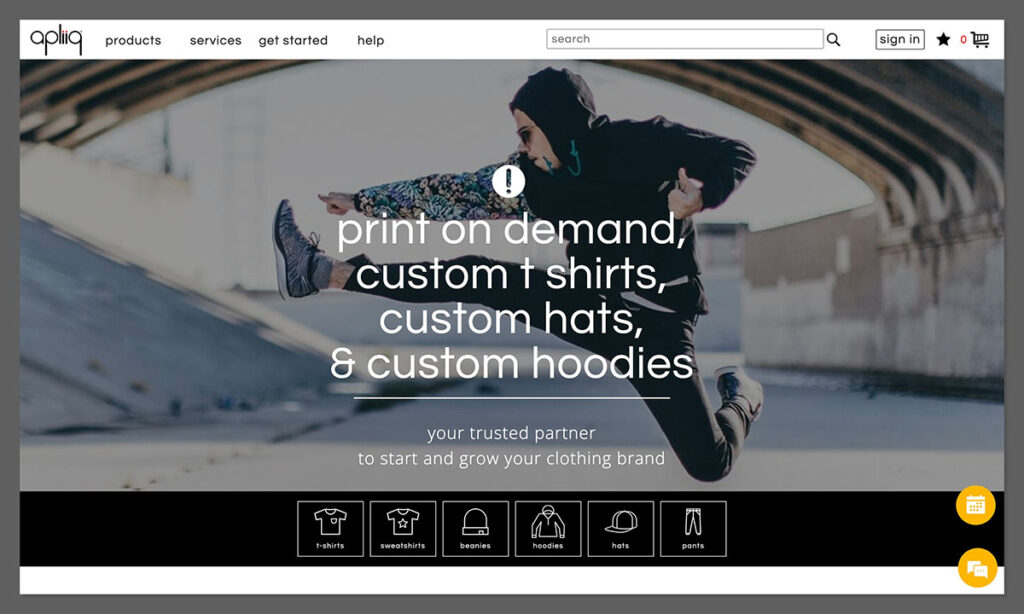
Most contract garment factories require 500 to 1,000 woven labels minimum. Apliiq does 100. That single number is what makes “real brand” branding accessible at startup volumes, and it’s why I keep recommending Apliiq to founders whose brand identity hinges specifically on the sewn-in label.
Apliiq is built for fashion, not for merch. Everything is cut, printed, embroidered, labeled, and shipped from Los Angeles and Philadelphia, which keeps quality control tight and gives you US-based support that can hop on a video call to walk through a design.
Branding Stack & Pricing
| Feature | Cost |
|---|---|
| Woven neck labels | $1.50-$3 each |
| Neck prints | $2.50 per unit |
| Embroidery (incl. 3D puff) | $6-$10 per placement |
| Base tee | $7-$12 |
| Full premium build (heavyweight blank, woven label, neck print, custom polybag) | $14-$18 per unit |
Blanks run from Bella+Canvas, AS Colour, and Yupoong. Hangtags, custom polybags, appliqué, and screen print on bulk drops are all available.
The cost math works out cleaner than you’d expect. Retail at $45 to $65 and you’re holding 60 to 70 percent gross margin while your product looks like it came out of a boutique on Melrose. That’s the point.
Pros
- Lowest woven-label MOQ in POD (100 units vs. 500 to 1,000 at contract factories)
- Full sewn-in branding stack: woven labels, neck prints, hangtags, custom polybags, embroidery, appliqué
- Premium blank roster (Bella+Canvas, AS Colour, Yupoong)
- US-based production in LA and Philadelphia with hands-on support
- 60-70% gross margin possible at $45-$65 retail
Cons
- Slow turnaround once branding is added (7-10 business days)
- Limited integrations: Shopify, Etsy, WooCommerce only
- No Amazon, TikTok Shop, or marketplace support
- International shipping slower than competitors with global facilities
- You build everything around the product yourself: store, tax, customer support
Best for: US-leaning streetwear and boutique brands selling at $45 and up, where the woven label is a hard requirement and 10-day turnaround is fine. Skip if: You need same-week shipping, international fulfillment, marketplace integration, or you’d rather not run an ecommerce operation around the product.
3. Tapstitch: Best for Heavyweight Streetwear Blanks
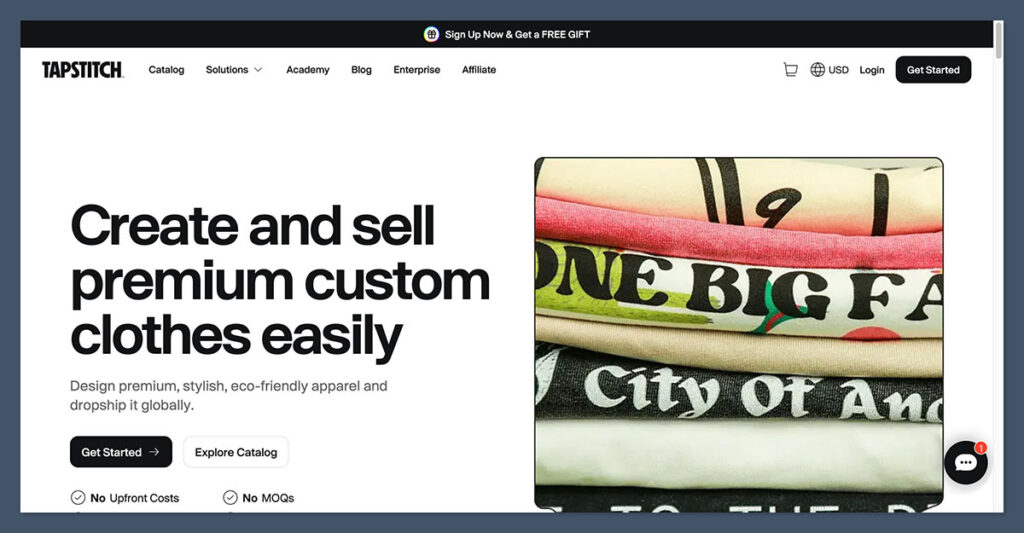
A standard Bella+Canvas 3001 weighs around 140 GSM. Tapstitch’s heavyweight tee runs 430 GSM, which is roughly three times the fabric. That’s the difference between “printed merch” and “fashion-grade tee,” and Tapstitch is the only mainstream POD I’ve found openly stocking blanks in that weight class.
Catalog & Specs
| Spec | Detail |
|---|---|
| Standard catalog weight | 250-380 GSM |
| Premium tee | 430 GSM (12.7 oz), $22.99 base |
| Silhouettes | Oversized cuts, drop shoulders, vintage washes, technical fabric |
| Print methods | DTG + DTF |
| MOQs / monthly fees | None |
| Inks & packaging | Eco-friendly standard |
| Fulfillment | US + global shipping |
DTG and DTF together matters more than you’d think. DTG is great for fine detail and full color on lighter fabrics; DTF gets you higher-opacity prints on dark heavyweights without the white-ink washout DTG sometimes produces.
You’re paying for that hand-feel. A 430 GSM tee at $22.99 base is roughly twice a Bella+Canvas 3001, which means you need to retail at $55 to $75 to hold margin. That’s fine if your brand identity is built around the fabric weight, but it’s a hard sell if you’re trying to play in the $25 to $35 retail range.
Pros
- Only mainstream POD stocking 430 GSM heavyweight blanks
- DTG + DTF combination handles dark fabrics without washout
- Streetwear-native silhouettes (oversized, drop shoulder, vintage wash)
- Eco-friendly inks and packaging standard
- No MOQs or monthly fees
Cons
- High base cost ($22.99) forces $55-$75 retail to hold margin
- No woven neck labels; only custom neck prints
- Apparel-only catalog (no mugs, posters, or accessories)
- Shipping speed varies more by region than competitors
- Reviewers consistently flag alignment issues if you skip sampling
If your brand identity hinges on the tee feeling thick and structured, Tapstitch is the only POD I’ve tested that ships that hand-feel out of the box.
4. Printful: Best Global Fulfillment with Real Branding
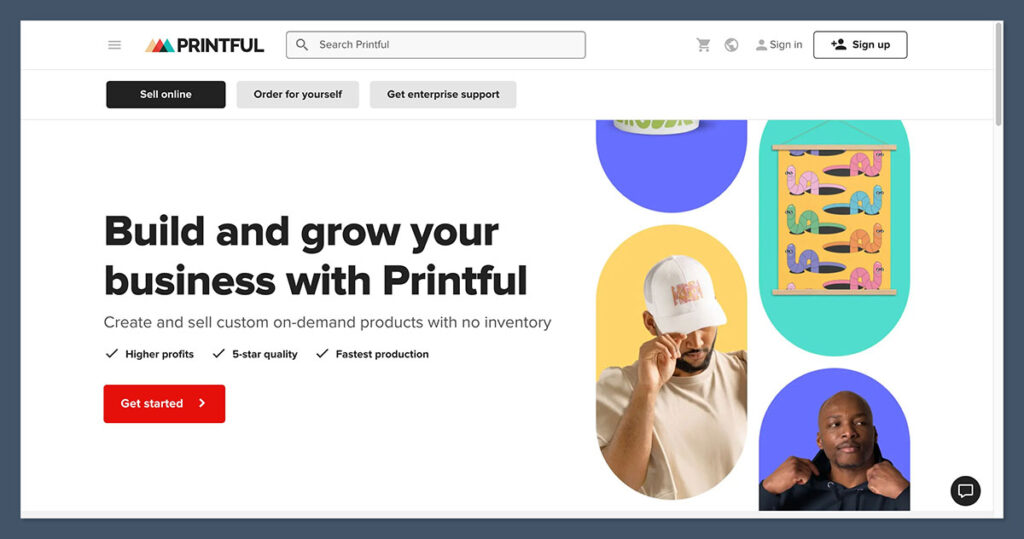
Printful gets called “the premium one” in every list, and the reputation is mostly earned. The branding ceiling is lower than most readers realize, though. The labels are printed transfers, not woven. The packing is branded, but it’s still a polybag. Knowing that up front changes how I’d recommend it.
Where Printful wins is fulfillment infrastructure. Auto-routing across the US, Mexico, Latvia, Spain, Canada, and the UK means orders ship from the closest facility automatically, not after a manual provider selection like Printify.
Branding & Pricing
| Feature | Cost |
|---|---|
| Custom inside labels | $0.99 |
| Custom outside labels | $2.49 |
| Bella+Canvas 3001 base | ~$11.75 |
| Full build with both labels | $15+ before shipping |
| Growth Plan | $24.99/month (free if store earns $12k/year), ~20% off products |
Branded pack-in cards, packing slips, and gift messages are all available. Sample orders ship at 20% off with free shipping.
Catalog & Integrations
- Print methods: DTG, embroidery, cut-and-sew, sublimation
- Integrations: Shopify, Etsy, Amazon, TikTok Shop, WooCommerce, Wix, Squarespace, Ecwid, BigCommerce
- Fulfillment hubs: US, Mexico, Latvia, Spain, Canada, UK (auto-routing)
To hold a healthy margin you need to retail at $30 or up, otherwise the labels and packaging compress the math fast.
Pros
- Broadest integration coverage of any single-network POD
- Global auto-routing across 6 fulfillment hubs (no manual selection)
- Real branded extras: pack-in cards, packing slips, gift messages
- Full print method coverage including cut-and-sew and sublimation
- Growth Plan free once store hits $12k/year
Cons
- Printed labels, not woven; premium customers can spot the difference
- No streetwear cut-and-sew silhouette catalog like Tapstitch or Apliiq
- Margin compression brutal below $30 retail once branding is stacked
- Branding adders ($3.48/unit) push base build to $15+
- You build the store, tax setup, and customer support yourself
Versus Apliiq, Printful wins on global shipping and integration breadth. Apliiq wins on actual brand feel. Versus Fourthwall, Printful has more fulfillment hubs and marketplace integrations, but you’re still operating an ecommerce business around it.
5. Gelato: Best for Global Premium with Auto-Routing
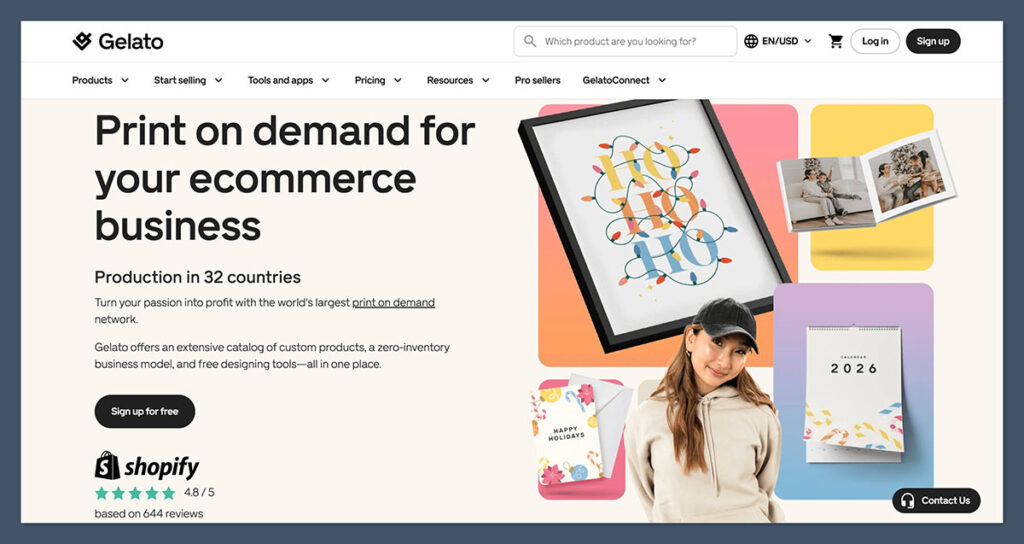
Most POD platforms claim “global fulfillment” but ship from one or two hubs, then watch international orders sit in transit for 10-plus days. Gelato actually fulfills around 90 percent of orders inside the destination country, which is the difference between “we ship globally” and “your German customer gets her tee in three days.”
Network & Specs
- 140+ print partners across 30+ countries
- Routing algorithm picks optimal partner per order (location, availability, speed)
- DTG and embroidery on Stanley/Stella, Cotton Heritage, Gildan blanks
- Built-in design editor with Shutterstock library access
- Personalization Studio for end-customer custom names/text at checkout
- ~250 products in catalog
Production Times
| Product | Speed |
|---|---|
| Posters & canvas | 1-4 days |
| Apparel | 2-6 days |
| Cards | 1-3 days |
Pricing
| Plan | Cost | Discount |
|---|---|---|
| Free | $0 | Standard pricing |
| Gelato+ | $25/month | 20% off products, branded labels unlocked |
| Gelato+ Gold | $129/month | 25% off products, 30% off branding |
Pack-in cards and branded labels run $0.70 each. Gelato+ Gold becomes real money once you’ve validated demand and you’re shipping at volume.
Pros
- ~90% of orders fulfilled in destination country (true local shipping)
- Cheapest branded labels in the market ($0.70)
- Auto-routing solves Printify’s biggest weakness
- Personalization Studio enables end-customer customization
- Free design editor with Shutterstock library
Cons
- Smaller catalog (~250 products) than Printful or Printify
- Cannot manually select production partner
- No 3D puff embroidery or woven labels
- US-only brands get better coverage from Printful
Best for: Premium brands selling internationally where local-country fulfillment matters. Skip if: You’re US-only. Printful does that scenario better.
6. TPOP: Best for Sustainable Premium in Europe
Most POD platforms ship in standard polybags and call it a day. TPOP ships in plastic-free recycled packaging, prints with water-based inks, and runs paperless production from a single facility in France. That’s not retrofitted sustainability, it’s the product itself, and it’s the cleanest eco-story I’ve found in POD apparel.
Catalog & Sustainability
- Organic cotton tees, hoodies, totes, plus a handful of home goods
- Water-based inks (no PVC, no phthalates)
- Plastic-free recycled packaging
- White-label branding: custom packing slips, logos, inserts, sender details
- Single facility in France, paperless production
Pricing
| Plan | Cost | Includes |
|---|---|---|
| Free | €0 | Basic tools, no commission, 1 store, 100 creations |
| Growth | €30/month | 1,000 creations, 2 stores |
| Pro | €70/month | Unlimited creations, 5 stores, API access |
Native integrations with Shopify, Etsy, and WooCommerce. Base costs sit higher than Bella+Canvas-tier mass blanks, but the sustainability story justifies retail at €45 to €55 with the eco positioning baked in.
Pros
- Cleanest eco-story in POD: plastic-free packaging, water-based inks, paperless production
- Made-in-France story justifies premium European pricing
- White-label packaging becomes the unboxing moment
- No commission on Free plan
- Native Shopify, Etsy, WooCommerce integration
Cons
- Smaller catalog than the big networks
- Limited US fulfillment; adds 5-10 days transit for US customers
- No embroidery, no all-over print
- Minimalist sustainable silhouettes only (no streetwear/heavyweight drop-shoulder)
If your brand sells eco values to a European customer, TPOP is the obvious pick. The packaging alone justifies the price tier.
7. Printify: Best for Premium-Adjacent at the Lowest Cost
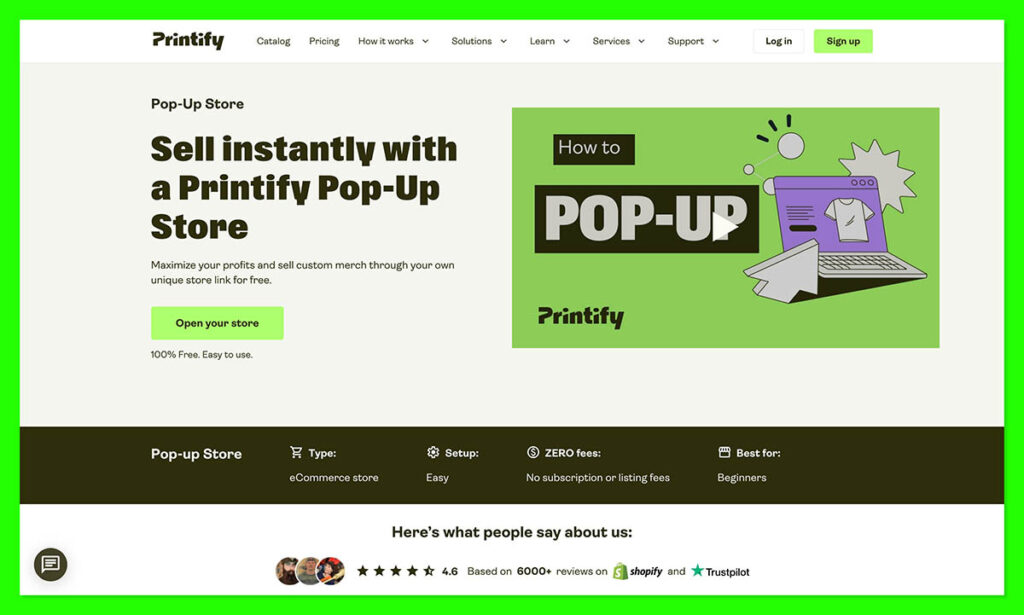
Printify gets a bad rap on premium lists, and most of it is fair. Quality varies wildly between providers because Printify isn’t one factory, it’s a marketplace of 80 to 140-plus providers running their own equipment to their own standards. But that’s also exactly how Printify can hit premium-adjacent specs at lower cost than Printful, if you’re willing to do the homework.
Platform Mechanics
- Network of 80-140+ print providers across 90+ countries
- Lowest base cost on most-traded SKUs (Bella+Canvas 3001 ~$11.75)
- Premium plan at $29/month unlocks 20% off products
- AI mockup tools and free Product Creator included
- Multi-platform integration coverage matches Printful
The Sample-and-Lock Workflow
The discipline that makes premium-adjacent work on Printify:
- Sample with three or four providers on the same SKU
- Pick the winner that hits your spec
- Lock that provider into your product setup
- Don’t let Printify auto-route
Top providers cited for premium specs: Monster Digital, SwiftPOD, Dimona.
If you skip the sample-and-lock work, you’re rolling dice on every order, and customers will get inconsistent product.
Pros
- Lowest base cost in the market on most-traded SKUs
- Massive provider network (80-140+) across 90+ countries
- Premium plan delivers 20% discount that Printful matches at higher monthly cost
- Multi-platform integration coverage matches Printful
- Best margin available on Bella+Canvas 3001 with the right provider
Cons
- No woven labels, no premium-tier branding stack
- Quality varies wildly between providers
- Customer support distributed across providers (slower resolution)
- International orders require manual provider selection
- Quality drift can happen silently when providers change equipment or staff
Best for: Margin-disciplined founders willing to sample and lock providers. Skip if: You can’t tell a 4 oz tee from a 6 oz tee in your hand. You’ll ship inconsistent product.
8. CustomCat: Best for Fast US Production with Embroidery
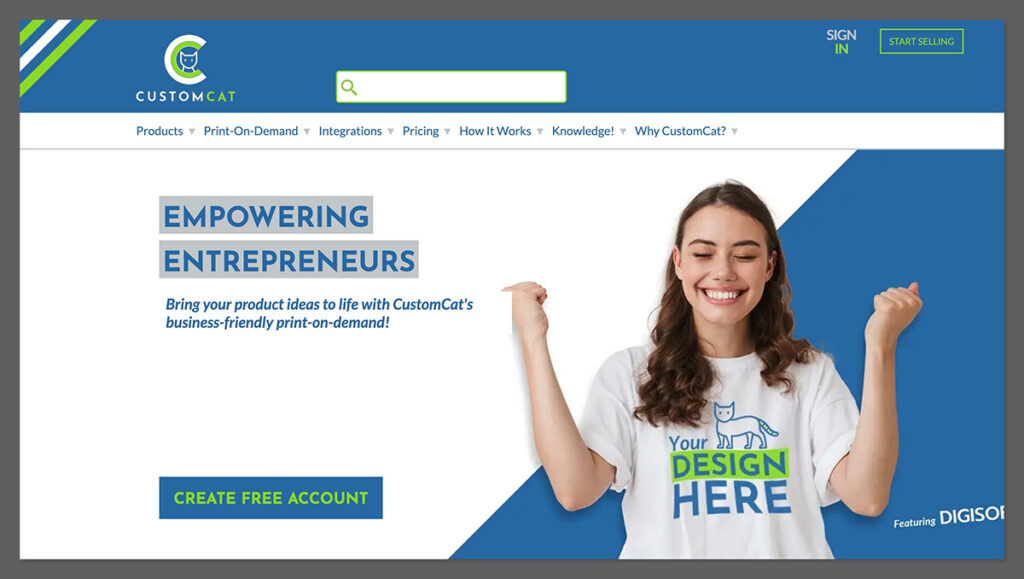
One to three day production from Detroit. Real embroidery, real proprietary print process, real Adidas blanks in the catalog. Fast US-based premium-capable POD is rare, and CustomCat is one of the few options that ships out before your competitors hit “fulfilled” in their order dashboard.
Production & Catalog
- Detroit-based, 1-3 day production
- DIGISOFT proprietary DTG/DTF hybrid handles dark heavyweights without DTG washout
- Blank roster: Bella+Canvas, Gildan, Hanes, Port Authority, Adidas
- Embroidery and dye sublimation alongside print
- Phone and email support included
Pricing
| Plan | Cost | Discount |
|---|---|---|
| Lite | Free | Retail-tier base costs |
| Pro | $30/month ($25/month annual) | 20-40% off products, priority support |
The math flips meaningfully past about $1,500/month in revenue. Founders running 500-plus orders per month on the Lite plan are leaving real money on the table.
Pros
- Fast US production (1-3 days from Detroit)
- DIGISOFT print process handles dark fabrics without washout
- Real Adidas blanks in catalog
- Embroidery available alongside print and sublimation
- Phone and email support included (rare in POD)
Cons
- No woven labels; only printed inside labels
- Dashboard feels closer to 2018-era SaaS than 2026
- Non-US shipping is slow (up to 4 weeks international)
- No Amazon or eBay marketplace integration yet
- Lite plan margins don’t work at scale; Pro is required past $1,500/month
Versus Printful, CustomCat wins on US speed and DIGISOFT print quality on dark fabrics. Printful wins on global routing and integration breadth. If you’re US-focused and your bestseller is an embroidered hoodie, CustomCat is the call.
FAQ
What actually makes a POD platform premium?
Three things, and you can usually tell from a platform’s spec sheet whether it has them: blank quality (200 GSM and up, ideally from AS Colour, Stanley/Stella, Cotton Heritage, or Lane Seven), branding stack (woven neck labels that are sewn in rather than printed, hangtags, custom polybags, optional embroidery and appliqué), and print method match (DTG for fine art, screen print for streetwear graphics, cut-and-sew for true all-over print). Fourthwall hits the first and third best of any all-in-one creator platform; Apliiq hits the second most completely with its woven-label MOQ of 100 units.
Can I run a real fashion brand on Printful or Printify?
Yes for the print and fulfillment, no for the branding ceiling. Both stop at a printed inside label and a polybag. If your brand depends on woven neck labels, hangtags, or luxury packaging, you’ll either need Apliiq or you’ll need to graduate to bulk manufacturing. Printful and Printify are good enough when retail price is under $35 and the brand is built on graphics. They’re not good enough when the brand is built on materials, fit, and finish.
How many washes does a POD print last?
The industry-accepted standard for DTG is 50 or more washes before noticeable fade, but only if the garment is washed inside out, in cold water, and air dried. Hot wash plus tumble dry can cut that lifespan in half. Run a wash test before scaling: order three samples, wash one cold and air dry, wash one hot and tumble dry, and keep one untouched as a control. If the print fades or cracks before 30 washes on the abuse cycle, switch providers.
Do I need cut-and-sew or is DTG-on-blanks enough?
DTG on premium blanks works for almost every front-print, back-print, and chest-logo design. Cut-and-sew (where panels are printed flat then sewn into a garment) is only required for true edge-to-edge all-over prints or fully custom silhouettes that can’t be sourced from a stock blank. The cost typically only makes sense when you’re retailing at $60 or up. Most premium founders never need it; they just need a heavier blank and better branding.
What’s the cheapest way to add real branding to a POD tee?
Printful’s $0.99 inside label is the cheapest “looks branded” option, but it’s a printed transfer, not a woven tag. For sewn-in branding, Apliiq woven labels start at $1.50 per unit with a 100-unit minimum. That 100-unit MOQ is the lowest in POD. Most contract garment factories require 500 to 1,000 woven labels minimum, which is why Apliiq is often the only practical path for a startup brand that wants real labels without committing to a bulk run.
When should I graduate from POD to bulk manufacturing?
When a single SKU consistently sells 100-plus units per month, the bulk math starts beating POD. Per-unit cost typically drops 40 to 60 percent at typical bulk MOQs of 100 to 300 units, and on a popular tee that single change can double net margin. Below that velocity, POD’s no-inventory flexibility wins, especially if you’re still testing styles. When you do graduate, match the bulk spec to your POD recipe (same blank, same print method, same label) so customers don’t notice the change. The transition is invisible if you do it right and obvious if you don’t.
Should I sample before launching every product?
Yes, on every platform, every time. Order at least three samples of any new SKU before listing it. Look at print alignment, label placement, fabric hand-feel, and packaging. Most platforms discount samples 20 percent and ship free. Skipping the sample is the most expensive shortcut in POD. Tapstitch reviewers consistently flag alignment issues when creators skip the sampling step, and Apliiq founders have caught label misplacements before they shipped to customers. Treat samples as quality insurance, not a cost.


