


Business owners — we get it. You’re stretched thin across sales, service, marketing, and operations, making every moment — and every mistake — expensive. So stop just doing business; and start automating it. You don’t need a larger team: you need an AI-assisted one. The future of efficiency is here, and it’s not just another software upgrade. It’s agentic artificial intelligence (AI) or simply, agentic AI.
This guide will break down the terminology of what the agentic AI era means and everything you need to know to scale fast with smart tools.
Let’s start by defining our terms: What is agentic AI?
Agentic AI is smart intelligence that has been trained to act autonomously on your behalf. In the context of productivity, think of it as the ultimate digital assistant: a self-driving, workflow engine that takes initiative, learns from every interaction, and completes tasks from start to finish — all within the guardrails you set.
Agentic AI is designed to operate autonomously toward a specific goal. It differs from regular chatbots because it’s been taught to reason: breaking down a goal into tasks they execute, monitoring progress, and making adjustments as needed. For a startup, this means less time spent micromanaging processes and more time spent securing investment.
The key components of an agentic AI system are:
- The goal: A high-level objective, such as “Onboard all new customers who purchased our Pro Suite this week” or “Resolve all pending tier-2 support tickets.”
- The plan: The agent breaks the goal down into concrete steps (Verify purchase, send welcome email, update customer relationship management (CRM) record).
- Execution: The agent uses tools — like your existing CRM — to perform the necessary actions.
- Reflection: The agent analyzes the results of its actions and adjusts the plan if it hits a roadblock, ensuring a successful outcome.
AI Tools for Small Business
The ability for the system to reflect and adjust is what makes it “agentic,” and fundamentally different from a simple bot. For example, if a standard automation tries to send an email and the recipient’s address is bad, it fails. The agentic AI layer of your tool might recognize the failure, search your customer database for a secondary email, and try again, reporting the outcome, whether sent or not, to the team. This level of problem-solving reduces the need for human intervention. To learn more about this process, explore the digital labor agents available today.
Example of Agentic AI: Agentforce 360 is Salesforce’s platform that embeds agentic AI capabilities directly into its leading customer relationship management (CRM) system. For small businesses, this means the power of autonomous AI agents are made accessible to enable smart, contextual actions across sales, service, and marketing workflows. By integrating agentic AI into the CRM, Agentforce 360 allows SMBs to automate complex, cross-functional tasks, increasing efficiency and enabling smaller teams to scale customer engagement rapidly.
Kickstart your SMB with Starter Suite
See results from day one with a CRM designed for SMBs — the all-in-one suite for productivity. It all starts with Starter Suite.
Essential agentic AI terminology for small business owners
As you begin to integrate agentic AI into your growing business or startup, you’ll encounter lots of new terms. Understanding this vocabulary will help you communicate effectively with your technology partners and define your AI strategy.
Here is a quick list to get started:
- Accountability: The policy that determines who is legally and ethically responsible when an agent makes a mistake. “The AI did it” is not a legal defense.
- AI agent: The specific software entity or “bot” within an agentic system that performs the tasks. It’s goal-oriented and uses tools to act on data.
- AI CRM: A customer relationship management (CRM) system that embeds AI capabilities directly into its core functions, providing the context and intelligence needed for agents to act effectively.
- Agentic AI: An autonomous AI system that can plan, execute, monitor, and adjust a sequence of actions to achieve a high-level goal, acting as digital labor.
- Application Programming Interface (API): A standardized set of rules (written as code) that allows two different pieces of software to talk to each other and exchange information.
- Chain of Thought (CoT): The process where an agent “thinks out loud” to solve a problem. You can see this happening when an agent responds to your prompt with its thought process. It’s vital for complex tasks like inventory forecasting or logistics.
- Digital Labor: A digital workforce of intelligent AI agents that augments your human workforce.
- Generative AI: AI that creates new content (text, images, code) in response to a prompt. Agentic AI uses generative AI for tasks like drafting personalized emails.
- Grounding: This means training the AI to stay rooted in facts. If an agent is “grounded” in your product catalog, it won’t hallucinate prices that don’t exist.
- Guardrails: The predefined rules, security protocols, and ethical boundaries set by the business owner that the AI agent must operate within, ensuring compliance and brand safety.
- Human in the Loop (HitL): A deployment strategy where the AI agent performs a task and then pauses to get human review or approval before executing a critical final step.
- Latency: How long it takes an LLM to create a response to a prompt. Some programs take longer depending on how much data you give it to analyze.
- Orchestration: This is the “manager” layer of Agentic AI. It’s how an agent decides which sub-tasks to do in what order.
- Predictive AI: AI that analyzes historical data to make forecasts or predict future outcomes, such as customer churn risk or optimal sales channels.
- Prompt Engineering: The practice of crafting highly specific and effective input queries (prompts) to guide a generative AI model to produce the desired, high-quality output.
- Reflection: The agent’s ability to self-critique its progress, identify roadblocks, and automatically generate a new, adjusted plan to complete the original goal.
- Retrieval-Augmented Generation (RAG): A software system that sits outside your LLM that fetches (retrieves) the data on behalf of the LLM, which then generates a result.
- Shadow AI: When employees use AI tools (like a personal ChatGPT account) for work tasks without company approval.
- Tool Use: The agent’s ability to use existing business software and APIs (like email, calendar, or data) to carry out the steps in its plan.
Why these terms matter to growing businesses
For SMBs and startups, mastering these terms is important because it moves the conversation from simply using AI features to adopting a scalable operating model.
Understanding agentic AI allows you to focus on automating entire workflows rather than just single tasks. Terms like ‘AI CRM’ and ‘guardrails’ emphasize the need for a data foundation and secure deployment, which are non-negotiable for future funding rounds and compliance.
For limited teams, a self-correcting AI agent is a powerful tool. By automatically handling tasks and sustaining productivity, this technology enables a small team to effectively manage a customer volume typically handled by a much larger organization.
5 Steps to Implementing AI Agents for Small Businesses
Learn how to get your AI agent up and running in no time with this free e-book.

Agentic AI and Salesforce
Salesforce’s Agentforce 360 platform integrates agentic AI directly into the world’s leading AI CRM, making this advanced technology accessible and immediately useful for small businesses and startups. This integration is key because it gives the autonomous agents a unified view of all customer data, enabling them to act with context, intelligence, and personalized precision across the entire customer lifecycle.
By combining the autonomous capabilities of agentic AI with the comprehensive data in a Salesforce CRM, SMBs can automate highly complex, cross-functional workflows that were previously impossible without extensive human oversight.
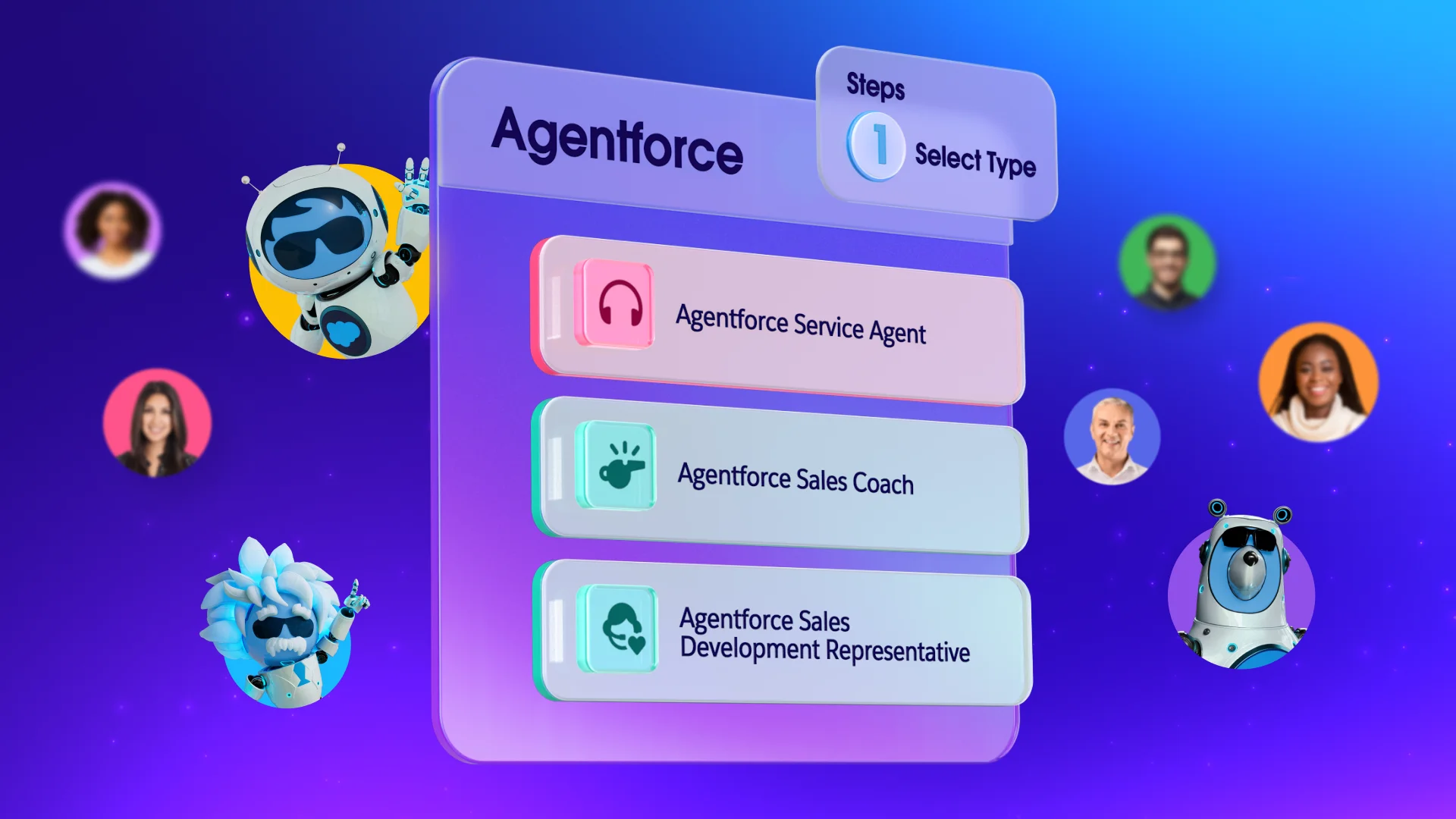
Agentic AI for your small business is possible
You can learn these terms easily and add more to your arsenal by following along on Trailhead, Salesforce’s free online learning platform. Here are a few more resources to keep the momentum going:
Start your AI journey with the Free or Starter Suite today. Looking for more customization? Explore Pro Suite. Already a Salesforce customer? Activate Foundations to try out Agentforce 360 today.
AI supported the writers and editors of this article.
Frequently Asked Questions (FAQs)
Agentic AI is an autonomous system that plans and executes a sequence of actions to achieve a complex goal. Generative AI is a technology that creates new content in response to a prompt. Agentic AI often uses generative AI as a tool, such as drafting a personalized email.
With platforms like Agentforce 360 integrated into an AI CRM like Salesforce, agentic AI is no longer a tool just for large enterprises. Small businesses can start small by automating one high-impact workflow (such as lead triage) using existing CRM infrastructure and scalable, subscription-based suites.
No. Agentic AI replaces “the work of work”: the repetitive, administrative tasks that lead to burnout. It handles tasks like data entry, ticket triaging, and sales follow-up sequences. This frees up your human team to focus on high-value, strategic work, like creative problem-solving and building deep customer relationships.
Guardrails are the security protocols, ethical rules, and business policies you define for your AI agent. They ensure the agent operates within safe and compliant boundaries, preventing it from accessing sensitive data inappropriately, making incorrect brand statements, or acting outside of your defined procedures.
An AI agent improves through reflection. After executing a step or a full task, it reviews the outcome against the original goal. If it hits a roadblock, it uses this reflection to generate a new, adjusted plan and tries again. This continuous, self-correction process allows it to “learn” from its attempts and become more effective over time.


