


Email authentication is no longer a backend configuration task. In 2026, it directly impacts deliverability, brand trust, and security posture. With stricter enforcement from mailbox providers and increasingly sophisticated phishing attacks, organizations can no longer afford partial or incorrect implementations of DMARC, SPF, and DKIM.
Yet, most companies still struggle. They either haven’t implemented DMARC, remain stuck in monitoring mode, or lack visibility into all their sending sources. PowerDMARC is built to solve exactly this problem.
It is not just a reporting tool. It is a full-scale email authentication and enforcement platform that combines automation, hosted infrastructure, analytics, and threat intelligence into a single system. This review takes a practical, real-world look at how PowerDMARC performs, where it delivers value, and whether it justifies its cost.
TL;DR
What It Is
PowerDMARC is an end-to-end email authentication platform that helps businesses implement, monitor, and enforce DMARC, SPF, DKIM, and related protocols with automation and hosted infrastructure.
Why It’s Critical
In 2026, email authentication directly impacts deliverability, domain security, and brand trust. Most organizations struggle with enforcement, leaving them exposed to spoofing, poor inbox placement, and lack of visibility.
Core Components
- DMARC management with guided enforcement
- Hosted SPF, DKIM, MTA-STS, and BIMI services
- Advanced reporting and analytics dashboards
- AI-driven threat intelligence
- Built-in tools and multi-tenant MSP capabilities
PowerDMARC’s Role
PowerDMARC bridges the gap between visibility and enforcement by simplifying complex configurations, centralizing control, and enabling safe, incremental rollout of authentication policies.
Business Value
- Improves email deliverability and inbox placement
- Reduces spoofing and phishing risks
- Cuts DNS and infrastructure complexity
- Enables scalable email security across teams and domains
- Replaces multiple tools with a single unified platform
What Is PowerDMARC
PowerDMARC is a cloud-based email authentication platform designed to help organizations implement, monitor, and enforce key protocols:
- DMARC (Domain-based Message Authentication)
- SPF (Sender Policy Framework)
- DKIM (DomainKeys Identified Mail)
- MTA-STS and TLS-RPT
- BIMI (Brand Indicators for Message Identification)
Unlike basic DMARC analyzers, PowerDMARC adds an operational layer on top by turning visibility into execution. Instead of just showing reports, it enables you to actively manage and optimize your email authentication setup through features like hosted SPF to avoid DNS lookup-limit issues, hosted DKIM for simplified key deployment and rotation, guided DMARC policy rollout from monitoring to enforcement, and centralized control over multiple protocols including SPF, DKIM, DMARC, BIMI, MTA-STS, and TLS-RPT—all from a single interface, so teams can quickly identify issues, fix misconfigurations, and enforce policies without relying on manual DNS changes.
At a strategic level, the platform sits between lightweight tools and complex enterprise suites. It delivers enterprise-grade functionality without overwhelming implementation complexity.
Why PowerDMARC Matters in 2026
Three major shifts make PowerDMARC increasingly relevant.
- First, enforcement has tightened. Gmail and other providers now expect proper authentication, especially for bulk senders.
- Second, email ecosystems have become fragmented. Organizations use multiple tools like CRMs, marketing platforms, and support systems, each acting as a sender.
- Third, threats are more advanced. Attackers exploit misconfigurations rather than just spoofing domains.
Most organizations fall into one of these categories:
- No DMARC set up at all
- DMARC is set to monitoring mode (p=none) with no enforcement
- Limited visibility into all the tools and services sending emails on their behalf
This leads to:
- Domain spoofing risks
- Poor email deliverability
- Lack of actionable insights
PowerDMARC addresses this by simplifying setup, visualizing activity, and enabling controlled enforcement.
Core Features of PowerDMARC
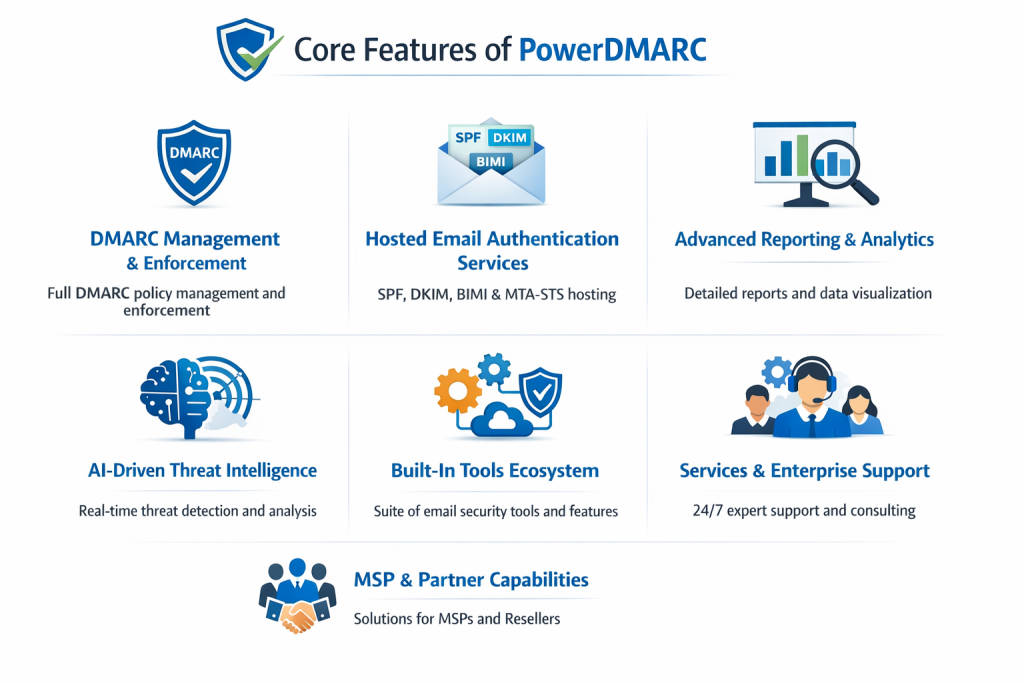
PowerDMARC is best understood as a system that moves you from visibility to enforcement.
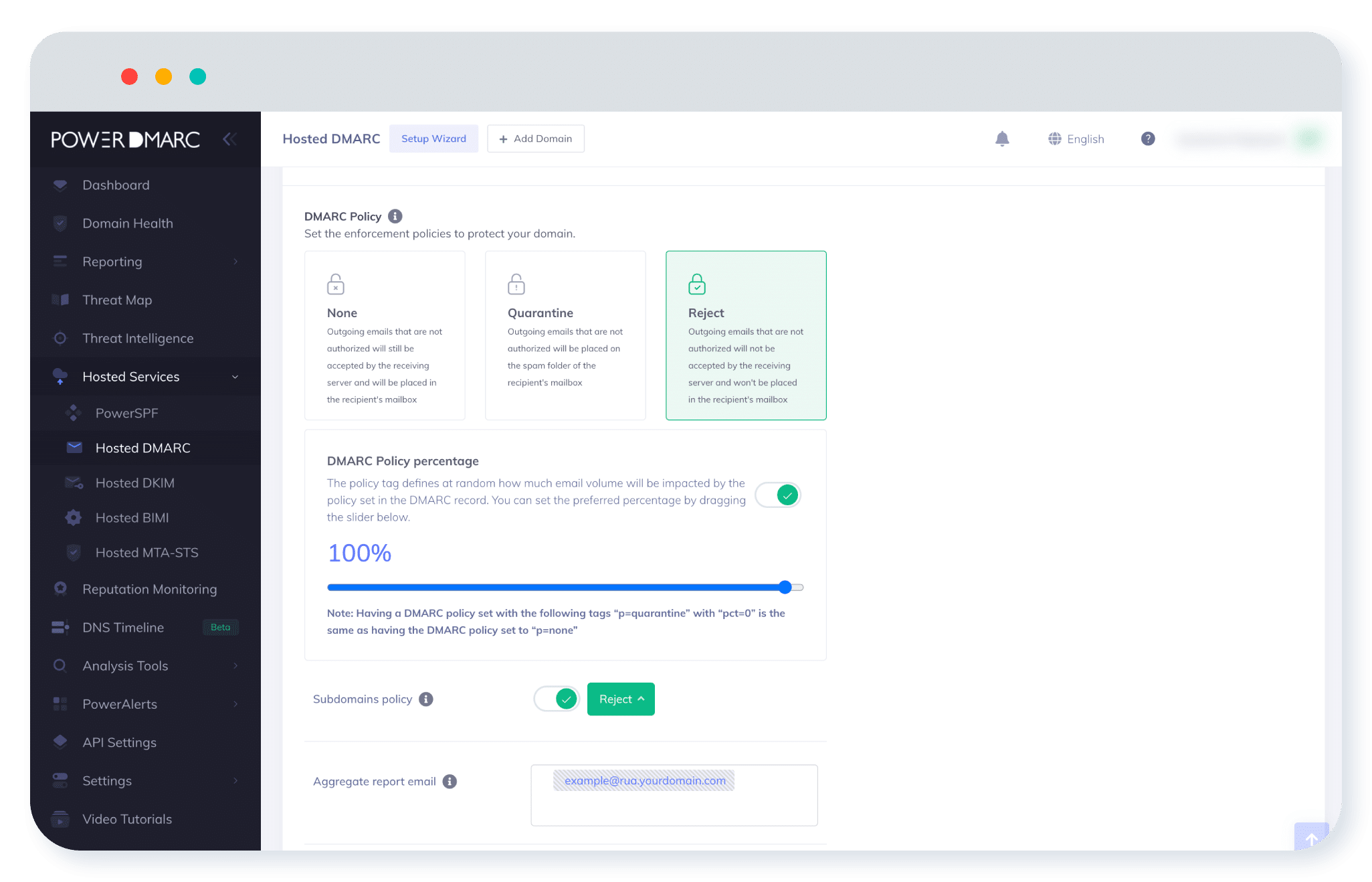
1. DMARC Management and Enforcement
This is the platform’s core strength.
It provides a guided setup process, alignment checks, and a structured transition from monitoring to enforcement.
Key capabilities:
- Guided DMARC setup wizard
- Policy transition (none → quarantine → reject)
- SPF and DKIM alignment validation
- Subdomain policy control
Why this matters:
Moving to enforcement is where most organizations fail. A wrong configuration can block legitimate emails.
PowerDMARC reduces that risk through:
- Incremental rollout
- Clear failure insights
- Data-driven decision making
2. Hosted Email Authentication Services
This is where PowerDMARC clearly differentiates itself.
Included hosted services:
Hosted DMARC
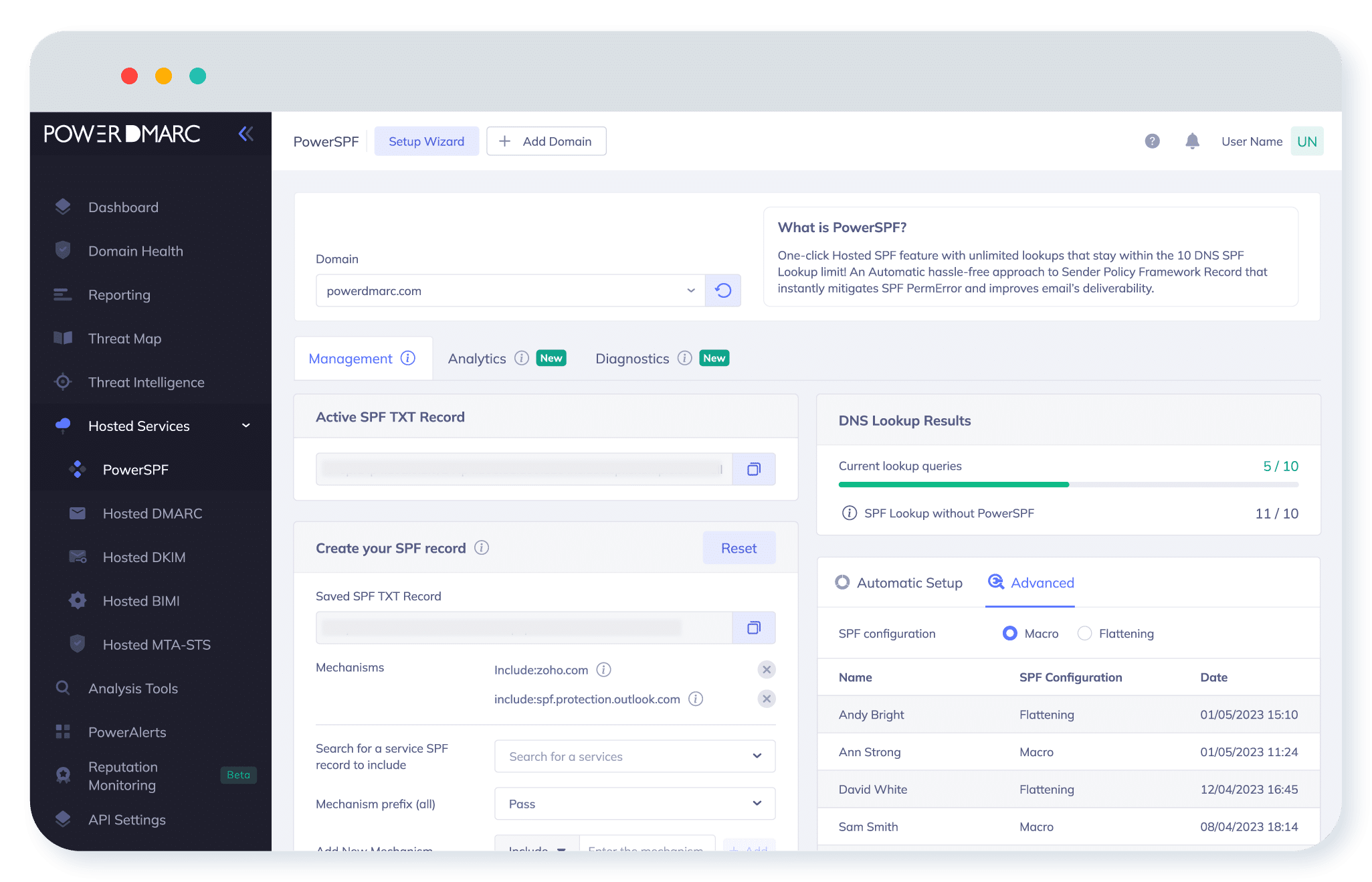
Hosted SPF
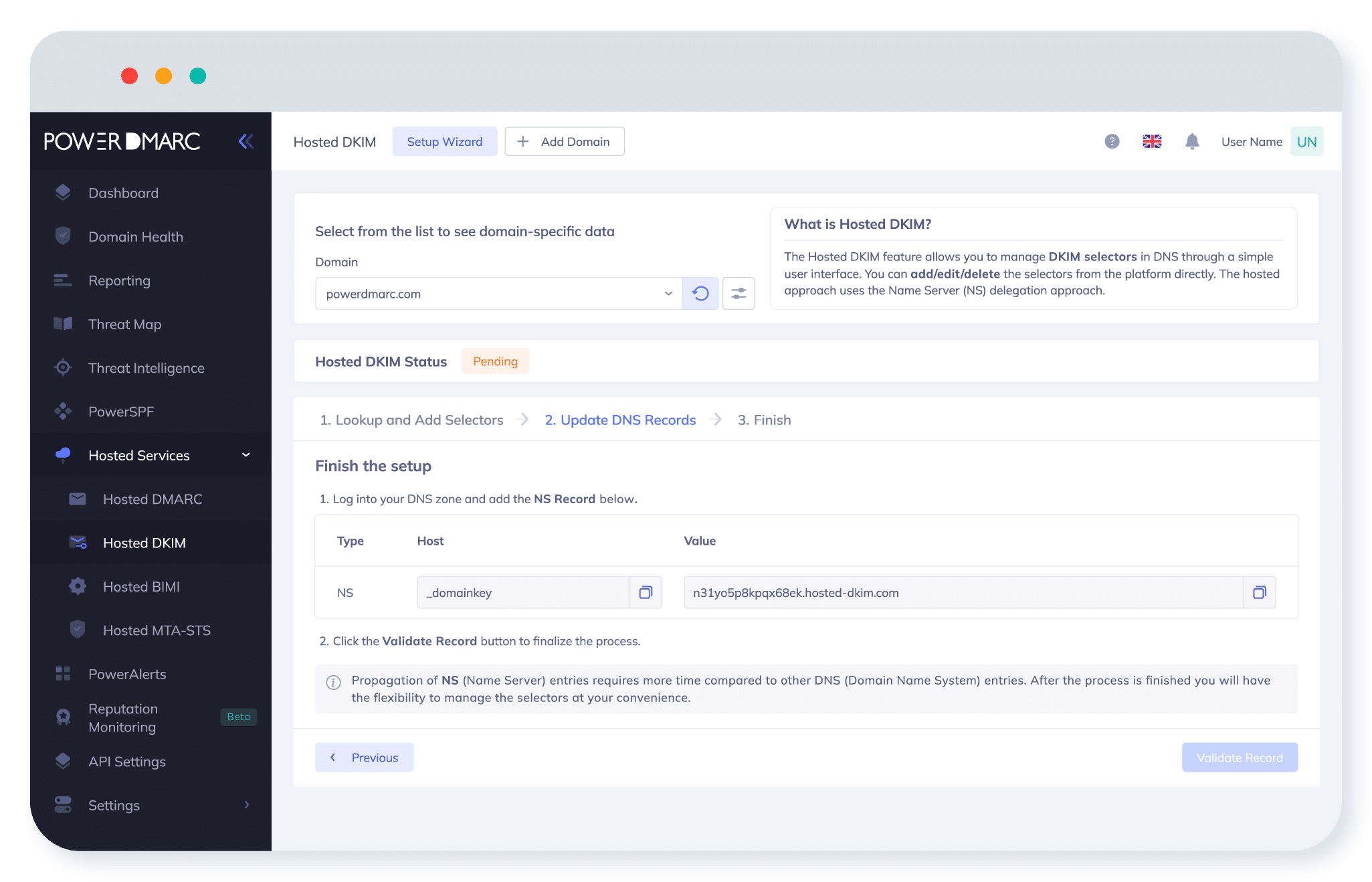
Hosted DKIM
Hosted MTA-STS
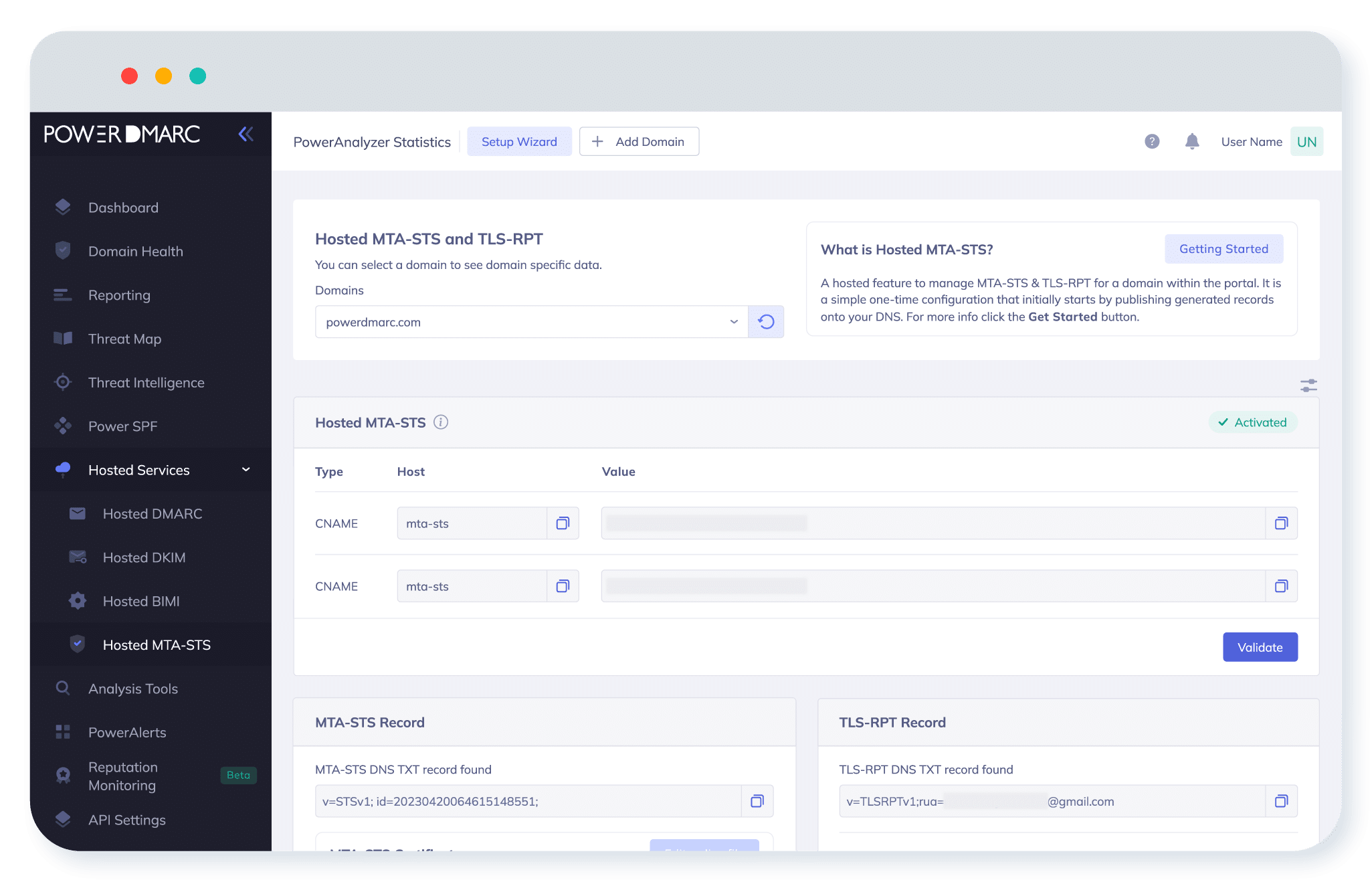
Hosted BIMI
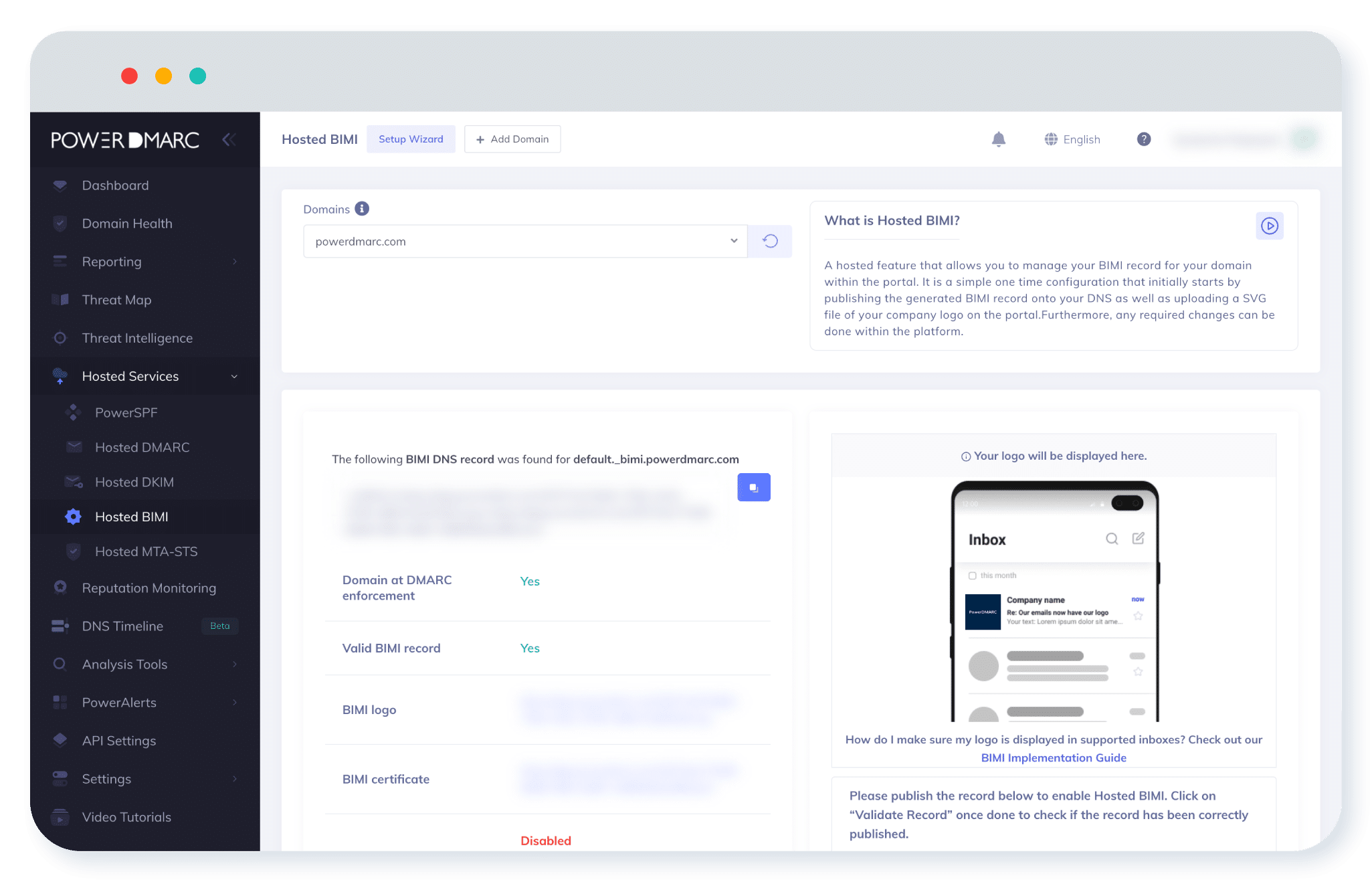
Without hosted services:
- SPF records hit DNS lookup limits
- DKIM rotation is manual
- MTA-STS setup is complex
With PowerDMARC:
- Everything is centrally managed
- DNS complexity is reduced
- Misconfiguration risk drops significantly
This is especially valuable for teams without deep email infrastructure expertise.
3. Advanced Reporting and Analytics
DMARC reports are raw XML files. PowerDMARC turns them into usable insights.
What you get:
- Visual dashboards
- Source-level visibility
- Authentication success rates
- Geographic insights
- Historical trends
Reporting breakdown:
| Feature | Value |
| Aggregate reports | High-level traffic overview |
| Forensic reports | Deep failure analysis |
| Source identification | Detect unauthorized senders |
| Trend analysis | Track improvements over time |
This shifts teams from reactive troubleshooting to proactive optimization.
4. AI-Driven Threat Intelligence
PowerDMARC adds context to authentication data through built-in intelligence.
Capabilities include:
- Spoofing detection
- Malicious IP identification
- Domain abuse monitoring
Real-world value:
- Faster threat detection
- Better prioritization
- Reduced exposure
It is not a standalone security platform, but it meaningfully enhances visibility.
5. Built-in Tools Ecosystem
PowerDMARC’s built-in tools ecosystem eliminates the need for multiple external utilities by bringing everything into a unified workflow. Instead of switching between fragmented tools, teams can manage their entire email authentication setup from a single platform. It includes essential authentication tools along with advanced utilities.
What this includes:
- Authentication tools:
DMARC checker and generator
SPF checker and generator
DKIM checker and generator - Additional utilities:
BIMI generator
TLS-RPT checker
DNSSEC checker
Email header analyzer
6. Services and Enterprise Support
PowerDMARC goes beyond being just a software platform by offering a comprehensive layer of services and support designed for organizations operating at scale. It combines hands-on assistance with intelligent automation to simplify deployment, improve security posture, and accelerate policy enforcement. This is further enhanced by an AI assistant that helps interpret reports, troubleshoot issues, and guide users through setup and policy changes—making email authentication more actionable, efficient, and easier to manage end-to-end.
Available Services:
- Deployment and onboarding support to ensure a smooth and secure implementation
- Managed services for ongoing monitoring and optimization
- Threat intelligence feeds to identify and mitigate spoofing and phishing risks
- Compliance assistance for standards like DMARC, GDPR-aligned practices, and industry requirements
- BIMI certification support, helping businesses obtain the Verified Mark Certificate (VMC) required for logo display in inboxes
AI-Powered Assistance:
- Interprets DMARC, SPF, and DKIM results in a clear, actionable way
- Troubleshoots authentication and configuration issues
- Guides users through setup, optimization, and DMARC policy rollout decisions
This is especially useful for organizations without in-house expertise.
7. MSP and Partner Capabilities
The platform is built with service providers in mind.
Key features:
- Multi-tenant dashboard
- White-labeling
- API integrations
- Volume-based pricing
This makes it suitable for agencies and MSPs managing multiple clients.
PowerDMARC Pricing Overview (2026)
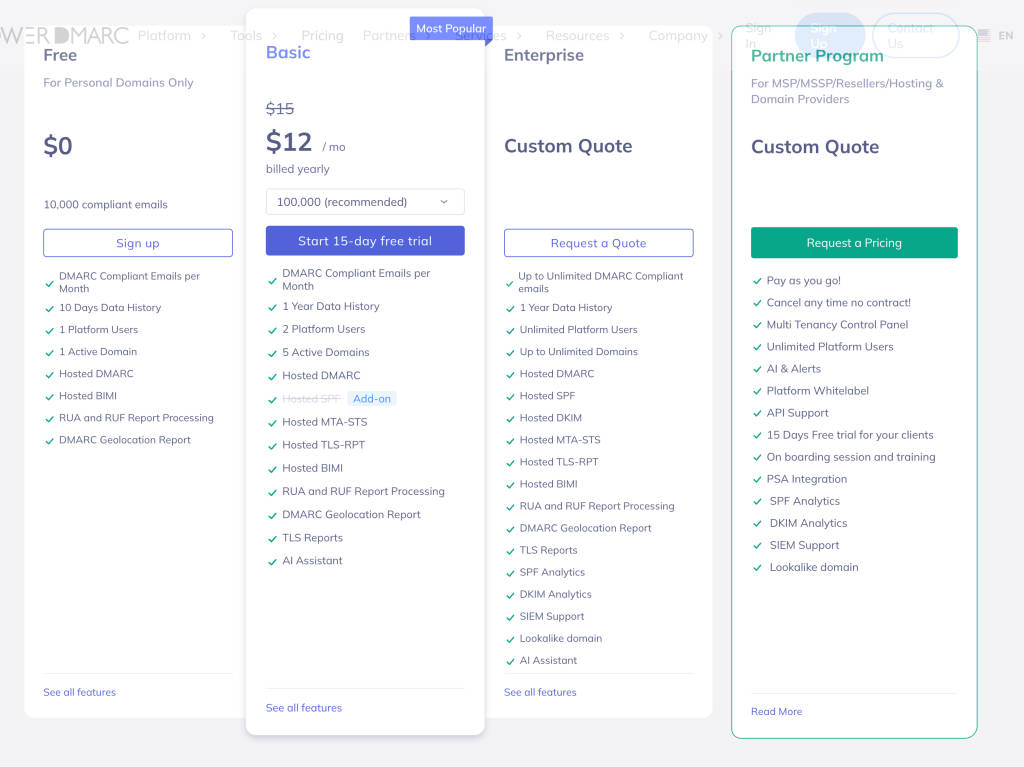
PowerDMARC follows a tiered, usage-based pricing model that scales with email volume, number of domains, and feature depth. Instead of rigid plans, the platform is designed to grow alongside your email infrastructure maturity. At a high level, pricing aligns closely with organizational complexity rather than just company size.
| Plan | Starting Price | Best Fit |
| Free | $0 | Testing and personal domains |
| Basic | Starts at $12/month | Small to mid-sized businesses |
| Enterprise | Custom pricing | Large, complex environments |
| Partner | Custom pricing | MSPs and service providers |
Key insight: PowerDMARC’s pricing is less about “how big you are” and more about how complex your email ecosystem is. A mid-sized company using multiple sending tools may outgrow Basic faster than a larger but simpler setup.
Plan Breakdown and Practical Fit
Free Plan
The Free plan is primarily designed as an entry point into DMARC visibility, rather than a long-term solution.
Includes:
- Up to 10,000 emails
- 1 domain
- Limited reporting
- Basic data retention
Best suited for:
- Initial testing
- Personal or low-volume domains
- Teams exploring DMARC for the first time
Insight: This plan is useful for understanding your email landscape, but it lacks the depth needed for enforcement. Most businesses will outgrow it quickly once visibility turns into action.
Basic Plan
The Basic plan introduces operational capabilities, making it the first tier where PowerDMARC becomes truly valuable.
Includes:
- Starts at $8/month (annual billing)
- Up to 5 domains
- Hosted DMARC, SPF, and DKIM services
- Alerts and analytics
- 1-year data retention
Best suited for:
- Growing businesses managing multiple email tools
- Teams moving from monitoring to partial enforcement
- Organizations without deep email infrastructure expertise
Insight: This is the sweet spot for SMBs. The inclusion of hosted services significantly reduces DNS complexity, which is often the biggest blocker in DMARC implementation.
Enterprise Plan
The Enterprise plan is where PowerDMARC transitions into a fully scalable email authentication platform.
Includes:
- Custom pricing based on usage
- Unlimited domains and scaling
- Advanced reporting and analytics
- Dedicated support
- Full hosted infrastructure (DMARC, SPF, DKIM, MTA-STS, BIMI)
Best suited for:
- High email volume organizations
- Enterprises with multiple sending sources
- Security and compliance-driven teams
Insight: At this level, the value shifts from tooling to risk management and operational efficiency. The cost is typically justified by improved deliverability, reduced spoofing risk, and lower manual overhead.
Partner Program
The Partner plan is tailored for MSPs, agencies, and resellers who manage email authentication across multiple clients.
Includes:
- Multi-tenant dashboard
- White-label capabilities
- API integrations
- Volume-based pricing
Best suited for:
- Managed service providers
- Email security consultants
- Agencies offering domain protection services
Insight: This is not just a pricing tier but a business enablement layer. It allows partners to productize email authentication as a service, creating recurring revenue streams.
Key Pricing Insights
- You are not charged for malicious traffic
Unlike some platforms, PowerDMARC does not bill for spoofed or fraudulent emails. This ensures pricing reflects actual usage, not attack volume. - Hosted services drive real cost savings
While pricing may appear higher than basic tools, the inclusion of hosted SPF, DKIM, and MTA-STS reduces:
- DNS management overhead
- Engineering effort
- Risk of misconfiguration
- Costs scale with complexity, not just volume
Pricing increases with:
- Number of domains
- Email volume
- Feature usage
But the bigger driver is how many systems are sending emails on your behalf.
- Transition cost vs long-term value
The real ROI comes after moving to enforcement:
- Better inbox placement
- Reduced phishing risk
- Improved domain reputation
SaaSworthy Take on Pricing
PowerDMARC is not the cheapest option in the market, and it is not trying to be.
It is priced for organizations that:
- Need to move beyond basic DMARC reporting
- Want to simplify complex email ecosystems
- Are willing to invest in long-term deliverability and security
For small teams with minimal email usage, it may feel excessive.
For growing and enterprise teams, it often replaces multiple tools and manual processes, making it cost-effective over time.
Bottom line:
You are not just paying for visibility. You are paying for control, automation, and risk reduction at scale.
PowerDMARC vs Alternatives
| Platform | Best For | Core Strength | Weakness | Pricing (Indicative) | Key Differentiator |
| PowerDMARC | Organizations of all sizes—from SMBs and MSPs to mid-market and enterprise—needing full-stack email authentication and policy enforcement | All-in-one (DMARC, SPF, DKIM, BIMI, MTA-STS) + threat intel | Some advanced features gated behind add-ons | Starts ~$8/month, flexible enterprise pricing | Broadest authentication ecosystem in one platform |
| EasyDMARC | Teams wanting simplicity & fast setup | Clean UI, guided setup, compliance tracking | Less depth for complex enterprise needs | Free tier + ~$20/domain/month | Best onboarding + usability |
| Valimail | Enterprise-scale deployments | Automation, deep integrations (Microsoft, Salesforce) | Premium pricing, less SMB-friendly | Custom enterprise pricing | Fully automated DMARC enforcement at scale |
| DMARC Report (DMARCReport) | Data-driven teams & MSPs | Strong analytics, AI insights, transparent pricing | Less bundled ecosystem vs PowerDMARC | Starts ~$29/domain/month | Advanced reporting + visibility |
| Red Sift OnDMARC | Security-first orgs | Policy automation + strong security posture | Can be complex for beginners | Mid–high tier enterprise pricing | Security + compliance focus |
| dmarcian | Technical teams | Deep forensic data, flexible APIs | UI not as modern, steeper learning curve | Mid-tier pricing | Most transparent data control |
| Mimecast | Enterprises wanting bundled security | DMARC + full email security suite | Overkill if you only need DMARC | Premium enterprise pricing | Integrated email security platform |
Key takeaway: PowerDMARC wins on execution and usability, especially for teams moving toward enforcement.
SaaSworthy Insights
PowerDMARC stands out because it focuses on execution, not just reporting.
What it does exceptionally well:
- Simplifies DMARC enforcement
- Reduces DNS complexity through hosting
- Provides actionable insights, not just data
Where it delivers maximum value:
- High email volume environments
- Multi-platform sending setups
- Security-conscious organizations
Important consideration:
This is not a “set and forget” tool. It requires:
- Ongoing monitoring
- Policy adjustments
- Continuous optimization
Reddit Insights: What Real Users Say
What users like:
- Easier than manual DMARC setup
- Strong visibility into sending sources
- Clean dashboards and reporting
Common concerns:
- Pricing increases with scale
- Learning curve for beginners
- Requires active management
Overall sentiment: A powerful platform that delivers results when used correctly.
Pros and Cons
Pros
- End-to-end email authentication platform
- Strong analytics and reporting
- Hosted services reduce complexity
- Scales well for enterprises and MSPs
- Improves deliverability and domain trust
Cons
- Pricing not fully transparent
- May be overkill for small teams
- Requires understanding of authentication concepts
Who Should Use PowerDMARC
Best fit:
- Mid-sized to enterprise businesses
- High email volume senders
- Security-focused organizations
- MSPs and agencies
Not ideal for:
- Very small businesses
- Low email volume use cases
- Teams needing only basic monitoring
FAQs
Who should use PowerDMARC?
PowerDMARC is designed for organizations that need more than just visibility into email authentication—they need control, scalability, and the ability to act on insights.
It’s a strong fit for:
- SMBs looking for an easy way to implement DMARC, SPF, and DKIM without deep technical overhead
- MSPs managing email authentication across multiple client domains from a centralized platform
- Mid-market companies that need better visibility into third-party senders and structured policy enforcement
- Enterprise teams handling complex email ecosystems, multiple sending services, and strict security/compliance requirements
- Security and IT teams responsible for preventing spoofing, improving deliverability, and enforcing authentication policies
In short, PowerDMARC works best for any organization that wants to move from basic monitoring to full control and enforcement of their email authentication stack.
Is PowerDMARC easy to use?
Yes, especially compared to manual setups, but some technical understanding helps.
Does it improve deliverability?
Yes, proper authentication improves inbox placement.
Can it prevent phishing?
It significantly reduces spoofing and impersonation risks.
Is there a free trial?
Yes, a 15-day trial is available.
How long does implementation take?
Initial setup takes hours; full enforcement can take weeks.
Final Verdict
PowerDMARC is one of the most complete email authentication platforms available in 2026. It brings together automation, hosted infrastructure, reporting, and threat intelligence into a single, well-structured system.
For organizations dealing with growing email complexity, deliverability challenges, or security risks, it is a strong investment. If your needs are basic, simpler tools may suffice. But if you want to move from monitoring to enforcement with confidence, PowerDMARC is built for exactly that transition.
The post PowerDMARC Review 2026: Pricing, Features, Use Cases, and SaaSworthy Verdict appeared first on SaaSworthy Blog | Top Software, Statistics, Insights, Reviews & Trends in SaaS.


