


Shopify and Basecamp are two of the most recognised names in their categories, but here is the catch: they do not solve the same problem.
We spent the equivalent of a full sprint analysing both platforms, mapping their feature sets, pricing, and where they actually fit in a modern ecommerce stack.
The short answer? Shopify runs your store. Basecamp runs your team. And if you are building an online business in 2026, you probably need both.
In this comparison, I will break down where each tool shines, where they fall short, and how to decide which one to start with based on the bottleneck in your business right now.
Shopify vs Basecamp: Quick Verdict
Here is the short version:
- Shopify – Best for selling online. The leading hosted ecommerce platform for DTC brands, multichannel retailers, and growing stores. Plans from $39/month.
- Basecamp – Best for running internal projects. A flat-fee project management and team communication tool that replaces a sprawl of apps. Not an ecommerce tool.
- Use both – Most ecommerce brands and agencies eventually run Shopify for transactions and Basecamp for team execution, connecting them through Zapier-style middleware.
In this guide, I will compare Shopify and Basecamp across pricing, core features, ease of use, integrations, and support, and explain why this is less of a versus and more of a stack decision.
Quick Comparison: Shopify vs Basecamp
Before going deeper, here is a side-by-side look at the two platforms:
| Dimension | Shopify | Basecamp |
|---|---|---|
| Category | Hosted ecommerce platform | Project management and team communication |
| Main buyer | Founders, ecommerce managers, retail operators | Agency owners, team leads, operations managers |
| Core job | Launch and scale a store across web, social, and retail | Coordinate work, tasks, and conversations in one place |
| Pricing model | Tiered monthly plans plus payment fees | Flat monthly fee for the whole team |
| Starting price | From $39/month | Flat team pricing with unlimited projects |
| Free trial | 3 days, then $1/month for the first 3 months | 30-day free trial |
| Extensibility | 8,000+ apps, deep APIs, headless ready | API for integrations, opinionated and simple |
| Best for | Anyone who needs to take money for products | Teams drowning in email and tool sprawl |
Best for Pricing: Basecamp (for predictability), Shopify (for value at scale)
Shopify and Basecamp use completely different pricing models, which makes the comparison less about cost per month and more about how cost scales with your business.
Shopify uses a tiered SaaS model with three main plans, each billed monthly or annually with a discount for the latter:
- Basic – $39/month, suitable for solo founders and new stores
- Shopify – $105/month, with lower card rates and professional reporting
- Advanced – $399/month, with advanced reporting and third-party shipping rates
- Shopify Plus – Custom pricing for high-volume merchants
You also pay payment processing fees on every order (Shopify Payments starts at 2.9% + $0.30 on Basic and drops on higher plans), and most stores end up adding a handful of paid apps. That is where the total cost of ownership creeps up.
Shopify currently runs a promotional offer of $1/month for the first 3 months on the Basic plan, which is useful if you want to launch a real store without committing to full pricing immediately. The free trial itself is only 3 days, which is short.
Basecamp takes the opposite approach. Instead of charging per user, it charges a flat monthly fee for the entire team, with unlimited projects and unlimited collaborators. There is also a per-user plan available for smaller teams. This is unusual in the SaaS world, where almost every project management tool (Asana, Monday, ClickUp) charges per seat.
The Basecamp model gets more attractive the bigger your team gets. A 30-person agency on a flat plan pays the same as a 5-person team, while the same agency on Asana would be paying per head. Basecamp also offers a 30-day free trial with no credit card required, which is far more generous than Shopify’s 3-day window.
The Winner
It depends on what you are buying. Shopify’s pricing scales with your store’s complexity and revenue. Basecamp’s flat fee makes budgeting predictable and gets cheaper per head as your team grows. They are not really competing on price because they are not competing for the same budget line.
Best for Selling Online: Shopify

This is the easiest section to write. Basecamp does not sell anything. It has no storefront, no product catalogue, no checkout, no payment processing. If you need to take money from customers, Shopify is the answer and Basecamp is not in the conversation.
Sales Features
Shopify is built end to end for commerce. Out of the box you get a product catalogue with variants, inventory tracking, discount codes, abandoned cart recovery, and multichannel selling across Instagram, TikTok, Facebook, Amazon, and Etsy. Shopify Magic, the platform’s AI layer, generates product descriptions, suggests email subject lines, and helps draft store copy.
Shopify also supports physical retail through Shopify POS, which is the same back office as your online store. Inventory and customer data are unified, which matters when a customer buys in store and returns online.
For B2B, Shopify includes wholesale storefronts, company accounts, and price lists on higher plans.
Basecamp, by contrast, is where you would plan a product launch, but not execute the sale. You can use it to assign tasks to your marketing team, store the launch brief, and chat with your manufacturer. None of that involves payments or inventory.
Payment Options
Shopify supports more than 100 payment gateways including PayPal, Apple Pay, Google Pay, Stripe, and dozens of local options. Its native gateway, Shopify Payments, removes the additional transaction fee that Shopify charges when you use a third-party processor. Transaction rates start at 2.9% + $0.30 on Basic and drop to 2.5% + $0.30 on Advanced.
Basecamp does not process payments. It can hold a project where you discuss your payment setup, but the actual transactions happen elsewhere.
App Market
Shopify’s app store has more than 8,000 third-party integrations, covering subscriptions, loyalty, shipping, accounting, B2B, ERPs, and more. The trade-off is that some core features that competitors include natively are app-dependent on Shopify, which can push up your monthly cost.
Basecamp’s integration ecosystem is much smaller and intentionally so. It connects to Zapier, has an API, and integrates with tools like Calendar, GitHub, and a handful of others. The philosophy is “keep the core simple,” which is the opposite of Shopify’s “extend with apps.”
The Winner
Shopify, by default. If selling online is the goal, Basecamp is not a substitute at any level. Shopify’s ecommerce depth, payment flexibility, and app ecosystem make it the platform of choice for stores at every stage.
Best for Managing Your Team and Projects: Basecamp
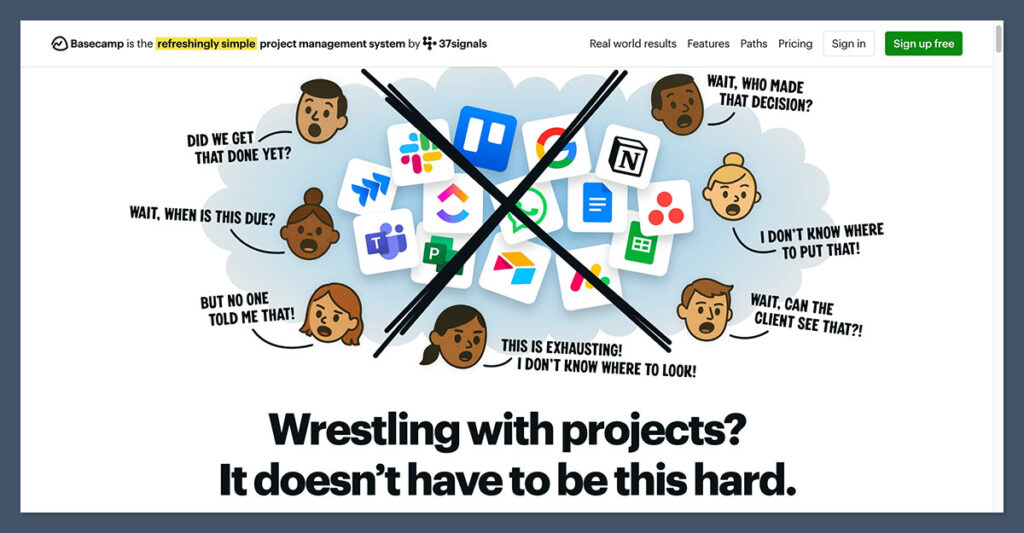
Now we flip the comparison. Shopify is not a team collaboration tool. It has merchant accounts and staff permissions, but it will not run your weekly standups, hold your launch checklist, or replace email threads. This is where Basecamp lives.
Project Spaces
Every Basecamp project bundles six things on a single page: message boards, to-do lists, schedules, docs and files, group chat (called Campfire), and automatic check-ins. The idea is that one project = one URL where everything related to that work lives. For agencies running multiple client accounts in parallel, this structure is hard to beat.
To-dos are simple. You create a list, assign owners, set due dates, and people tick them off. There are no Gantt charts, no kanban boards by default, no story points. This is deliberate. Basecamp’s bet is that most teams overcomplicate project management, and that a simpler model leads to more actual work getting done.
Communication Tools
Basecamp splits communication into three formats:
- Message boards – Asynchronous, threaded discussions for announcements, decisions, and longer updates. The format encourages writing things down instead of pinging people.
- Campfire chat – Real-time group chat per project, for quick back-and-forth without spawning a Slack channel.
- Automatic check-ins – Scheduled questions sent to the team (e.g., “What did you work on today?”) that replace status meetings.
Shopify has none of this. It has staff accounts and basic activity logs, but it is not designed to coordinate work between people. You would still need Slack, Teams, email, or Basecamp on top.
Documents and Files
Each Basecamp project includes a Docs & Files section where you store briefs, contracts, brand guidelines, design assets, and any other reference material tied to that work. It is not a Notion-grade wiki, but it is enough for most agencies and small teams to keep documents next to the work they describe.
Shopify has a Files section, but it is for product images, downloadable digital goods, and theme assets. It is not built for collaborative document storage.
The Winner
Basecamp, without contest. Shopify is not a collaboration platform. Basecamp consolidates tasks, chat, docs, and schedules into one calm workspace, which is exactly what teams drowning in tool sprawl tend to need.
Best for Ease of Use: Tied (in different ways)
Both Shopify and Basecamp are known for being approachable, but the experience differs depending on what you are trying to do.
Shopify’s onboarding is fast. You answer a short series of questions about what you sell and where, and you land on an admin dashboard with a setup checklist guiding you through adding products, configuring payments, choosing a theme, and going live. The store editor uses a section-based approach (not full drag and drop), where you stack design blocks like image carousels, product grids, and testimonials on a page. It is less flexible than something like Webflow, but it is far easier for non-designers to get a clean-looking store in a few hours.
Where Shopify can feel heavy is the sheer surface area. Between products, orders, customers, marketing, analytics, apps, and settings, there is a lot to learn. Most founders pick it up within a week of daily use, but the first hour can be disorienting if you have never run an ecommerce backend.
Basecamp’s interface is famous for being almost aggressively simple. The home screen shows your projects as cards. Click into one and you see the six tools arranged in a grid: Message Board, To-dos, Schedule, Docs & Files, Campfire, Check-ins. That is it. There are no sidebars stacked with views, no filters within filters, no custom workflows to configure. New team members tend to be productive within the first session.
The trade-off is that Basecamp deliberately does not give you the depth that more complex teams expect. If you want sprint reporting, time tracking, or dependency mapping, you will not find it here. That is by design, not omission.
The Winner
Both win for their target audience. Shopify is the most approachable serious ecommerce platform on the market. Basecamp is one of the easiest project tools to roll out to a non-technical team. Different jobs, both well-executed.
Best for Templates and Design: Shopify
This category does not really apply to Basecamp. The product looks identical for every customer because it is an internal tool. There are no themes, no public-facing storefronts, no branding customisation beyond a logo upload.
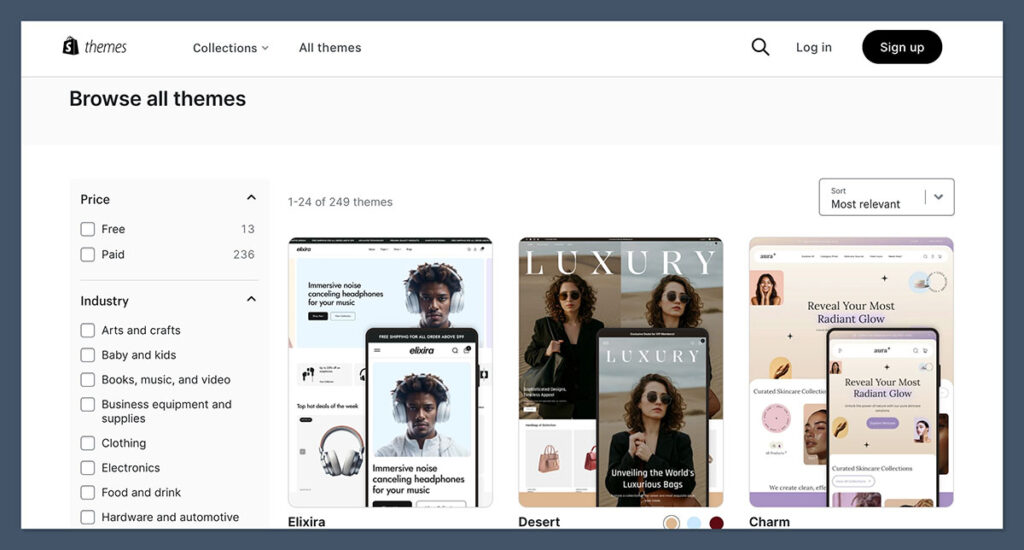
Shopify, by contrast, offers more than 190 themes in its Theme Store, split between free (around 13 options) and paid (typically $180 to $500 as a one-time charge). Themes are categorised by industry, with options optimised for apparel, electronics, food and drink, home goods, and more. Each theme is mobile-responsive by default and customisable through Shopify’s section-based editor.
For brands that want more, Shopify supports Liquid (its templating language) for deeper code customisation, and Shopify Plus customers can run fully headless setups with a custom frontend pulling from Shopify’s APIs.
The Winner
Shopify, by default. Design is core to its product because your store is your shop window. Basecamp simply does not compete here, because it does not need to.
Best for Integrations and Extensibility: Shopify (for ecosystem), Tied (for the stack)
The interesting question is not which platform has more integrations, but how they fit together.
Shopify’s app store sits at more than 8,000 integrations covering almost every category an ecommerce business could need: email marketing (Klaviyo, Omnisend), reviews (Yotpo, Loox), subscriptions (Recharge), shipping (ShipStation, Easyship), accounting (QuickBooks, Xero), and dozens of niche tools. Its Admin, Storefront, and Checkout APIs (the latter on Plus) allow custom builds, headless commerce setups, and deep ERP integrations.
Basecamp’s integration set is much smaller and more focused. It has a public API, supports Zapier and Make, and offers direct integrations with a handful of tools. The most relevant ones for ecommerce teams include:
- Zapier and Make for connecting Basecamp to almost anything
- GitHub and GitLab for engineering teams
- Calendar integrations for syncing schedules
- Time-tracking tools like Harvest and Everhour
The interesting workflows happen when you connect the two. Through Zapier, viaSocket, or PixieBrix, you can trigger Basecamp actions from Shopify events:
- New high-value order in Shopify → create a fulfillment to-do in Basecamp
- Customer support ticket flagged → create a Basecamp project with the customer history
- Product launch in Shopify → kick off a Basecamp campaign project with pre-populated to-dos
- Inventory below threshold → notify the operations team via Basecamp message board
This is where the “versus” framing breaks down. In a mature ecommerce operation, Shopify is the system of record for commerce data, and Basecamp is the system of record for execution.
The Winner
Shopify wins on raw ecosystem size. But in a real stack, the right answer is to connect them. Use Shopify as the source of truth for orders and customers, and pipe relevant events into Basecamp where your team coordinates the response.
Best for Customer Support: Shopify
Both companies offer support, but with very different philosophies.
Shopify provides 24/7 live chat through its Help Center, with escalation to human Support Advisors for complex queries. Shopify Plus customers get 24/7 phone support and a dedicated account manager.
The Help Center itself is extensive, including written guides, video tutorials, a community forum, Shopify Academy courses, and partner directories for finding agencies and freelancers. Social channels (Twitter/X, Facebook, YouTube) are also active.
The main limitation is that Shopify removed email support a while back, so if you prefer asynchronous email-style communication, you will need to use the chat queue or community forum instead. Priority support is reserved for Plus customers.
Basecamp’s support is smaller in scope but historically well-regarded. Email support is the primary channel, and the team is known for thoughtful, human responses, though not 24/7. There is also a comprehensive Help Guide, video tutorials, and Basecamp’s own books and essays (the company famously publishes opinionated content like Shape Up and Rework that doubles as product philosophy).
What Basecamp does not offer is round-the-clock live chat or phone support, which can be a friction point for teams in time zones outside US business hours.
The Winner
Shopify, on availability. 24/7 live chat plus a deep Help Center beats Basecamp’s email-first model when you need answers fast. Basecamp’s support quality is high, but the coverage window is narrower.
How We Compared Shopify and Basecamp
Because these tools serve different jobs, we did not score them on a single weighted ranking. Instead, we evaluated each platform across the categories that matter for its intended use case, then assessed where they overlap and where they complement each other in a real ecommerce stack.
| Evaluation Area | What We Tested | Weight |
|---|---|---|
| Core feature depth | How well each tool performs its primary job (selling vs coordinating) | 30% |
| Pricing and value | Total cost of ownership at small, mid, and enterprise scale | 15% |
| Ease of use | Onboarding, learning curve, and daily-use friction | 15% |
| Integrations and ecosystem | App stores, APIs, and ability to connect to the rest of a stack | 15% |
| Customer support | Channels available, response quality, documentation depth | 10% |
| Use case fit | Which business profiles each tool actually serves best | 15% |
Shopify vs Basecamp: Final Verdict
The right question is not “which one wins.” It is “which one do I need first, and when do I add the other.”
If you are starting an ecommerce business, you need Shopify.
There is no version of this where Basecamp solves the problem of taking money from customers. Shopify is the most complete hosted commerce platform on the market in 2026, and it remains the default choice for everyone from solo founders to brands doing nine figures of revenue.
If you are running a team that already sells (on Shopify or anywhere else) and your bottleneck is communication, project execution, or tool sprawl, that is when Basecamp earns its place.
Agencies running multiple Shopify builds for clients, in-house teams coordinating launches and campaigns, operations teams managing fulfillment and customer service: these are the workflows where Basecamp’s flat pricing and consolidated workspace start to pay off.
The strongest setup for most growing ecommerce brands is both: Shopify as the commerce engine, Basecamp as the team’s operating layer, connected through middleware so that data flows between them. That is the actual stack, not the versus.
Frequently Asked Questions
Can I use Basecamp instead of Shopify to run an online store?
No. Basecamp has no ecommerce functionality. It does not offer a storefront, a product catalogue, a checkout, or payment processing. You can plan an ecommerce business in Basecamp, but you cannot run one through it.
Does Shopify have project management features?
Shopify has basic merchant accounts, staff permissions, and activity logs, but it is not a project management tool. There are no to-do lists for your team, no message boards, no schedules, no internal chat. For team coordination, you will still need a tool like Basecamp, Asana, or Notion.
How do you connect Shopify and Basecamp?
The most common path is through Zapier or similar middleware (Make, viaSocket, PixieBrix), which lets you trigger Basecamp actions from Shopify events. For example, a new high-value order in Shopify can automatically create a to-do in Basecamp, or a customer service flag can spin up a project with the customer’s order history attached.
Which is cheaper, Shopify or Basecamp?
It depends on your business. Shopify’s costs scale with revenue (monthly plan + payment fees + apps). Basecamp uses flat team pricing that does not change as you add collaborators. For a 20-person agency, Basecamp is often cheaper than per-seat alternatives. For a solo founder running a small store, Shopify’s Basic plan is the lower upfront commitment.
Is Basecamp good for ecommerce agencies?
Yes, this is one of Basecamp’s strongest use cases. Agencies running multiple Shopify builds for different clients benefit from the per-project workspace structure, the unlimited collaborator pricing (clients can be added without per-seat costs on the flat plan), and the asynchronous communication tools that reduce reliance on Slack and email.
Are there better alternatives to Basecamp for ecommerce teams?
Asana, ClickUp, Monday, and Notion are all reasonable alternatives depending on what you value. Asana and ClickUp offer more advanced project structures (sprints, dependencies, multiple views). Notion adds a richer wiki layer. Basecamp wins on simplicity and flat pricing, and tends to be the right choice for teams that find other tools too complex or too expensive at scale.
Are there better alternatives to Shopify?
BigCommerce, WooCommerce, Wix, Squarespace, and Adobe Commerce all serve overlapping segments. BigCommerce competes most directly with Shopify and is often cheaper at higher tiers due to lower transaction fees. WooCommerce is popular for WordPress-native stores. Shopify remains the broadest choice for hosted commerce, especially if you want strong out-of-the-box features and minimal hosting management.


