


Unity is arguably the most popular game engine for indie game developers, especially when also pursuing a more stylised aesthetic. It is nonetheless just as capable of producing photorealistic visuals, with one of the most popular examples right now being the first-person extraction shooter Escape From Tarkov. A similar kind of realism is what indie studio Sunset Visitor aims to achieve with its next game, Prove You’re Human.
Partly, this is also down to the studio’s debut – the incredible 1000xResist – being made in Unity as well. But whereas that game had a striking anime-inspired art style depicting a post-apocalyptic far future in a society of clones, Prove You’re Human takes a different direction to engage with our more present concerns.
Finding fun in imperfection
From what has been revealed so far, when it was announced at the Triple-i Initiative, Prove You’re Human looks largely like a two-hander (if it makes you think of small theatre plays, that’s because some of the studio’s founders come from a performing arts background, which Siu says is “often about making two people in a room talking be very interesting”).
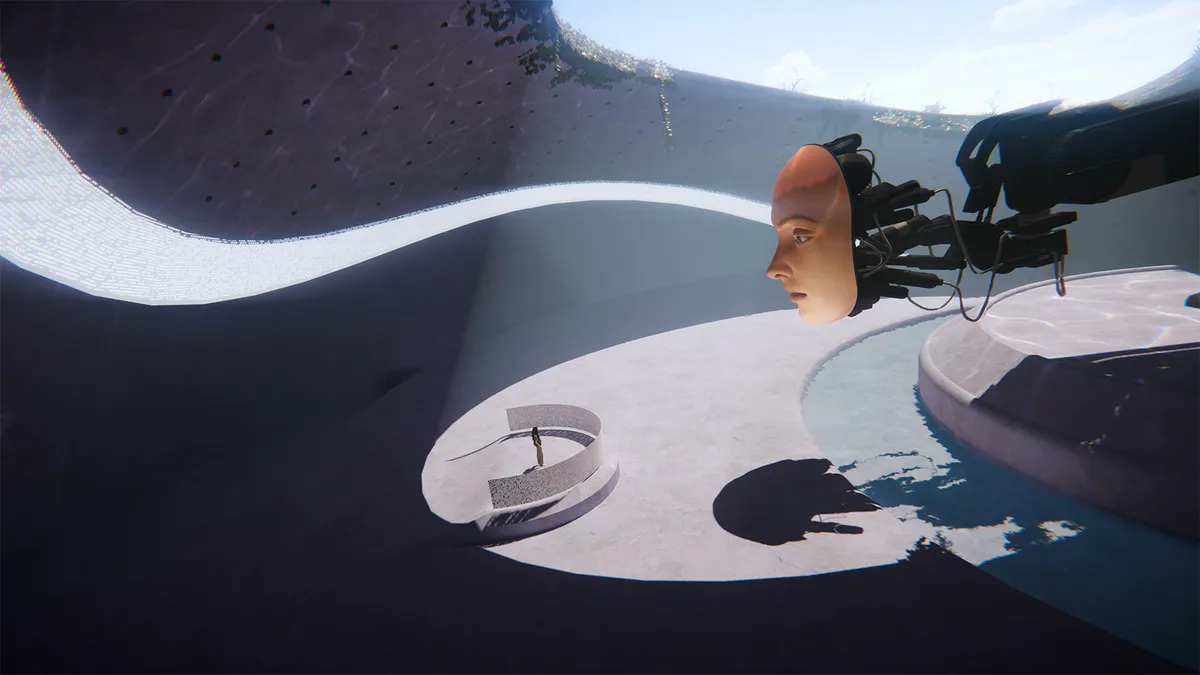
You play as Santana, who you control as a digital copy inside a virtual environment in order to test a new corporate product: an AI named Mesa. The problem is that this AI is also convinced that she is human, and so your task is to put her in her place.
You can then see why, as a way to make this premise feel real, Mesa has been designed not just as a disembodied voice or floating cypher like Portal’s GLaDOS, but with a distinctly human-looking face. Similarly, while you play as Santana in first-person, her virtual body is actually a photogrammetry scan of an actor. But if this is the kind of tech that Unreal Engine 5 is better equipped for, then there’s also some creative intent behind an imperfect tool for the job.
“With Mesa, the desire there was to lean into kind of an uncanny valley aspect of things,” Siu says. “We’re not like Kojima-scanning people, we want to purposely have slightly more janky scans because they produce interesting artefacts for us.”

Realism from FMV
Prove You’re Human also goes beyond photorealism to full realism by using live-action FMV. The medium has seen a resurgence in the past decade, notably with Sam Barlow’s critically acclaimed games like Her Story and Immortality, though there’s also a significant scene in 1000xResist that uses video footage of Hong Kong, repurposed from an unfinished documentary project Siu previously worked on. This time, the studio has hired filmmaker Sepehr Samimi, who shot the previous documentary footage, to capture original footage and handle photogrammetry scanning for the game.
“As artists, I feel like we can make a contribution to the conversation about what an FMV game is as it continues to develop,” Siu explains. “Another thing we identified was that in this story it allows us to make that very clear distinction in the diegesis – there’s a virtual world, and there’s a physical non-virtual world, which depicts your corporeal other in their physical body.”
I can imagine there’ll come a point where the lines between these worlds will also blur, if some of the freakier moments at the end of the trailer are any indication, though, of course, Siu is keeping his lips sealed. But one area where real assets enter the virtual world is through image-based CAPTCHA tests, which naturally tie into the game’s title.
Exploring AI themes
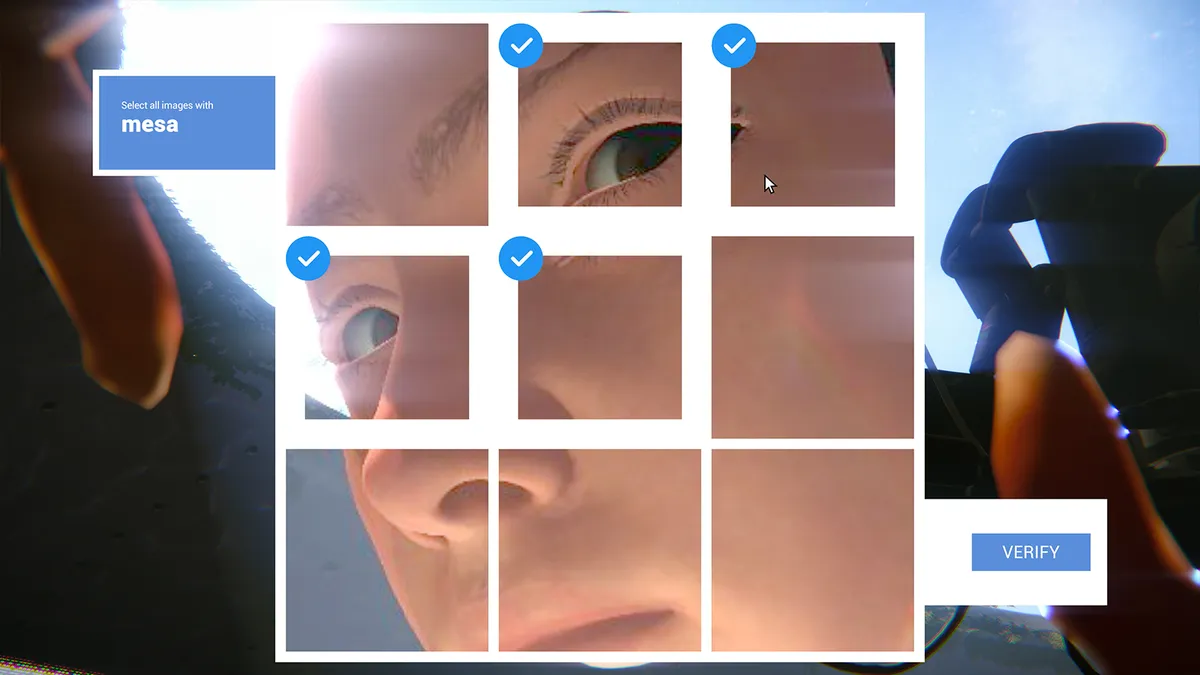
While CAPTCHA tests are normally used online to deter bots and spam, Prove You’re Human makes use of this feature in many of the game’s interactions, including when you’re conversing with Mesa. “It felt like a humorous way to get into [the AI themes], but it’s also kind of violent in that you have to define whether something is or isn’t something,” says Siu.
It’s certainly a way of making the game accessible to more people, given how widespread CAPTCHA tests are in our day-to-day interfacing with the internet. It also conveniently means there’s a public domain of CAPTCHA sets the team has been able to use, though, within that, there are also original images made from ‘found’ objects.
“For us, it’s just a lot of fun ways in which we often think about how to use this not only as an interactable but also a way of framing the world around you, where it’s like taking a photograph as well,” he concludes. “So it’s a way of kind of seeing the world, framing the world, and a bunch of other stuff that would be spoilers!”
Prove You’re Human is coming soon to PC, and you can wishlist it on Steam.