

No matter what the question, the solution isn’t to work harder; it’s to work smarter. You clicked on this article because you want to learn about delegating tasks better, right? So let’s get right to it — task delegation.
Delegating tasks to your team is really just assigning specific duties or responsibilities to better growth — simple as that. It’s also a strategic move that allows you to focus on high-impact, revenue-generating activities while making sure that all work gets done. Learning to delegate is a core leadership skill that equips your team, frees up your time, and ultimately sets your business up for sustainable scale.
What is task delegation and why is it important to SMBs?
Task delegation is the strategic assignment of specific duties, responsibilities, or projects from a leader (such as a founder or manager) to an employee or team member. In a business context, its purpose is to optimize the leader’s time for high-level, strategic priorities while empowering others to manage day-to-day operations and develop their skills.
For startups and small businesses, time is the most precious resource. When founders spend time on repeatable, low-value tasks, the business loses momentum.
Effective task delegation allows leaders to step away from the day-to-day and focus on the future, no matter what size the business. One study found that 75% of SMB leaders believe that technology is the answer to more efficient operations. Getting the work done is important, but making sure the right people are doing the right work is what fuels growth. Here is the value to look out for:
- Move high-volume, low-impact tasks off your plate so you can focus on vision, strategy, and business growth.
- Gives teams opportunities to own new responsibilities, building their confidence and capabilities for the future.
- Distributes workload across the team, reducing stress on leaders and ensuring a healthier work-life balance for everyone.
- Tasks are handled by the person best suited (or trained) to do them, leading to better quality and faster execution.
- Allows small teams to handle a greater volume of work without hiring immediately, preparing the business for growth.
Boost team productivity with Salesforce
The strategic shift: What to delegate and what to keep
One of the hardest parts of learning how to delegate is figuring out what should stay on your plate and what should be handed off. The key is to shift your mindset from “I must do this” to “who is the best person to do this?”
What to delegate
Look at tasks that are repeatable and take up a significant portion of your week but do not require your unique expertise. These are ideal candidates for task delegation. A perfect example is lead nurturing — once you’ve set up the basic strategy, a team member can manage follow-up emails and data entry within your small business marketing platform.
It’s helpful to analyze the tasks consuming your week and sort them by effort and impact. SMBs can benefit from using a unified platform where data insights make it clearer which processes are automated and which need human intervention.
What to keep
Tasks that you must keep include high-level strategy, major financial decisions, and sensitive customer relationships. These are tasks that use your specific vision and expertise as the founder. Delegating everything is a mistake; thoughtful delegation is the goal.
By delegating the day-to-day sales pipeline management, for instance, you can focus on building major partnerships or refining your overall business model. A strong customer relationship management (CRM) system gives your sales team the tools to manage their accounts, freeing you up for more strategy.
Boost team productivity with Slack
Bring together your team, your customers, and your tools to help take your business to the next level with Slack — it’s where business gets done.
The 5 things to know behind task delegation
1. The “why you aren’t doing it” (Internal barriers)
Most leaders struggle with delegation because of mindset, not lack of tools.
The “I Can Do It Better” trap — a barrier to delegation fueled by perfectionism and fear of losing control — causes manager overload, diverting focus from strategic duties. This hoarding of tasks stunts team development by preventing members from gaining experience and learning skills, fostering dependency and low morale. Retaking a poorly executed task only reinforces the trap and further demoralizes the team.
The “Control vs. Growth Paradox” complicates delegation: While immediate control ensures tasks are done “right” now, delegation builds long-term team capacity and autonomy. Avoiding delegation creates a bottleneck, widening the skills gap. Effective delegation builds “bench strength” and resilience, proving managerial control comes from distributed competence, not centralized execution.
2. The 5 levels of delegation
Not all delegation is “here, take this.” You should explain that there’s a spectrum:
Level 1: Do as I say (Investigator)
The manager instructs the employee on exactly what to do, with no deviation. This is for tasks that don’t require creativity.
Level 2: Research and report (Reporter)
The employee researches a topic and gathers information, however, the manager makes the final decision.
Level 3: Research and recommend (Advisor)
The employee researches the topic, outlines options, and recommends the best course of action. They then present it to the manager for approval.
Level 4: Decide and inform (Steward)
The employee makes a decision and takes action, then informs the manager of the outcome.
Level 5: Act independently (Owner)
The employee takes full ownership and acts without needing to report back, as the manager trusts their judgment.
3. The “How-to” framework (The anatomy of a task)
This is the practical “are you doing it right?” part.
Task delegation really requires clear communication of expectations without resorting to micromanagement. This involves explicitly defining the desired outcome, ensuring the delegate understands the “why” behind the task, and setting appropriate constraints. Crucial elements to establish upfront include any budgetary limitations, the deadline or time constraints for completion, and the level of authority the delegate has to make decisions or commit resources.
To maintain momentum and offer support without stifling autonomy, a system for checking in should be agreed upon. This avoids the negative perception of “hovering” while still providing the necessary oversight. The goal is to establish a rhythm of communication that keeps the task on track and allows for course correction, ensuring the delegate feels trusted yet supported in achieving the successful, desired outcome within the established parameters.
4. Common pitfalls: Signs you’re “doing it wrong”
Upward delegation: When employees bring the task back to your desk because it’s too hard.
Solution: Use detailed task logging within the CRM to provide clear steps and knowledge links, enabling targeted coaching on returned tasks instead of full reassignment.
Dumping vs. delegating: The difference between offloading “grunt work” and strategic sharing.
Solution: Automate repetitive “grunt work” using CRM flows and ensure strategic delegation is linked to high-level goals to communicate its value.
The “Shadow” task: When you delegate a task but spend just as much time “reviewing” it as it would have taken to do it yourself.
Solution: Utilize standardized CRM reporting and dashboards to define and quickly check measurable success metrics instead of conducting a manual review.
5. Measuring success
KPIs for task delegation include measuring the right metrics:
Team velocity: The increase in the number of tasks completed by the team within a set timeframe. This indicates improved productivity and resource allocation due to effective delegation.
Deep work: The growth in the leader’s time spent on complex, strategic, and important tasks that only they can handle. This confirms that lower-priority, delegable items are being managed effectively by the team, freeing up the leader for high-value work.
Measure your tasks with the right tools
Level up your business by transforming scattered data into actionable insights.


How to delegate using smart technology
Delegation isn’t just about handing over work; it’s about providing the necessary context, authority, and tools to succeed. For a modern small business, this often means using smart tech to ensure clarity and accountability.
Defining clear expectations and providing resources
Before delegating any task, you must clearly define your desired outcome, deadline, and key performance indicators (KPIs). Ambiguity is the enemy of effective task delegation. Ensure your team members understand why tasks are being delegated and how it contributes to the larger business goal. Include them in the entire process, all together — you guessed it, in a CRM tool.
Using a single source of truth, like a CRM tool built for task management, ensures that all team members are working with the same, up-to-date customer data. This is important when delegating customer service tasks, marketing tasks, sales tasks…you get it. A small business service CRM tool helps you pull all of your tasks together.
Kickstart your SMB with Starter Suite
See results from day one with a CRM designed for SMBs — the all-in-one suite for productivity. It all starts with Starter Suite.
Using AI to power your team
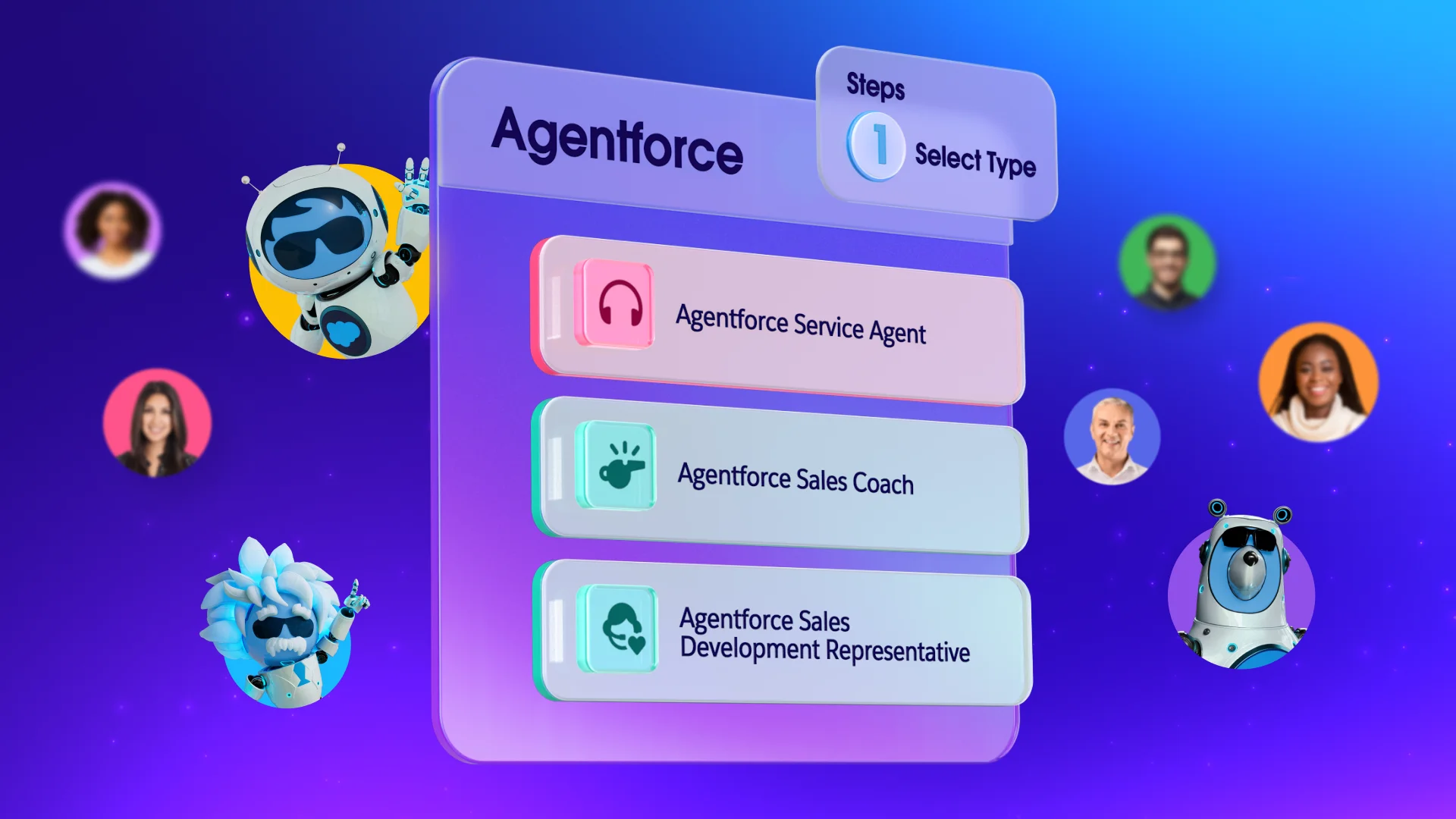
Artificial intelligence (AI) is now a powerful tool to make task delegation easier for you and your team. According to Salesforce data, 60% of SMB leaders believe generative AI will help them save time and increase efficiency. You can delegate tasks using AI tools, like Agentforce 360, to handle the most time-consuming parts.
For example, your marketing team can use AI to draft initial social media copy, accelerating a task that would have taken them hours. They can then use AI to schedule out that social copy for approvals across Slack, and load to a media planner for launch. All with a few clicks. Here are a few more ways you can use AI to help with task delegation:
- Automated triage: AI can analyze incoming requests (e.g., support tickets, sales leads) and automatically route them to the most appropriate team member based on their workload, skills, or past performance, effectively delegating the initial assignment task.
- Content generation: Tools can draft initial versions of routine content (e.g., email responses, social media posts, basic reports), allowing managers to delegate the entire “drafting” step to AI and employees to focus on review and refinement.
- Data synthesis: AI can compile performance metrics and summary reports on delegated projects, providing managers with instant, objective feedback for the “Closing the loop” stage without manual data aggregation.
- Process automation: AI-powered workflow automation handles repeatable, administrative tasks (like data entry, scheduling, or follow-up reminders) end-to-end, removing them entirely from the manager’s and team’s to-do list.
Closing the loop: The feedback process in task delegation
The final step in effective task delegation is implementing a structured feedback and review process. Regular check-ins and performance reviews are important to catch issues early and celebrate successes.
When reviewing a delegated task, focus on coaching and development rather than simply critique. Using analytics from your sales, service, and commerce platforms provides objective data to guide the conversation. If you delegated tasks for your online store, you can review performance metrics within your small business commerce tools to give feedback on ecommerce conversion rates. From there you can audit your online shop, and sell with these insights in mind.
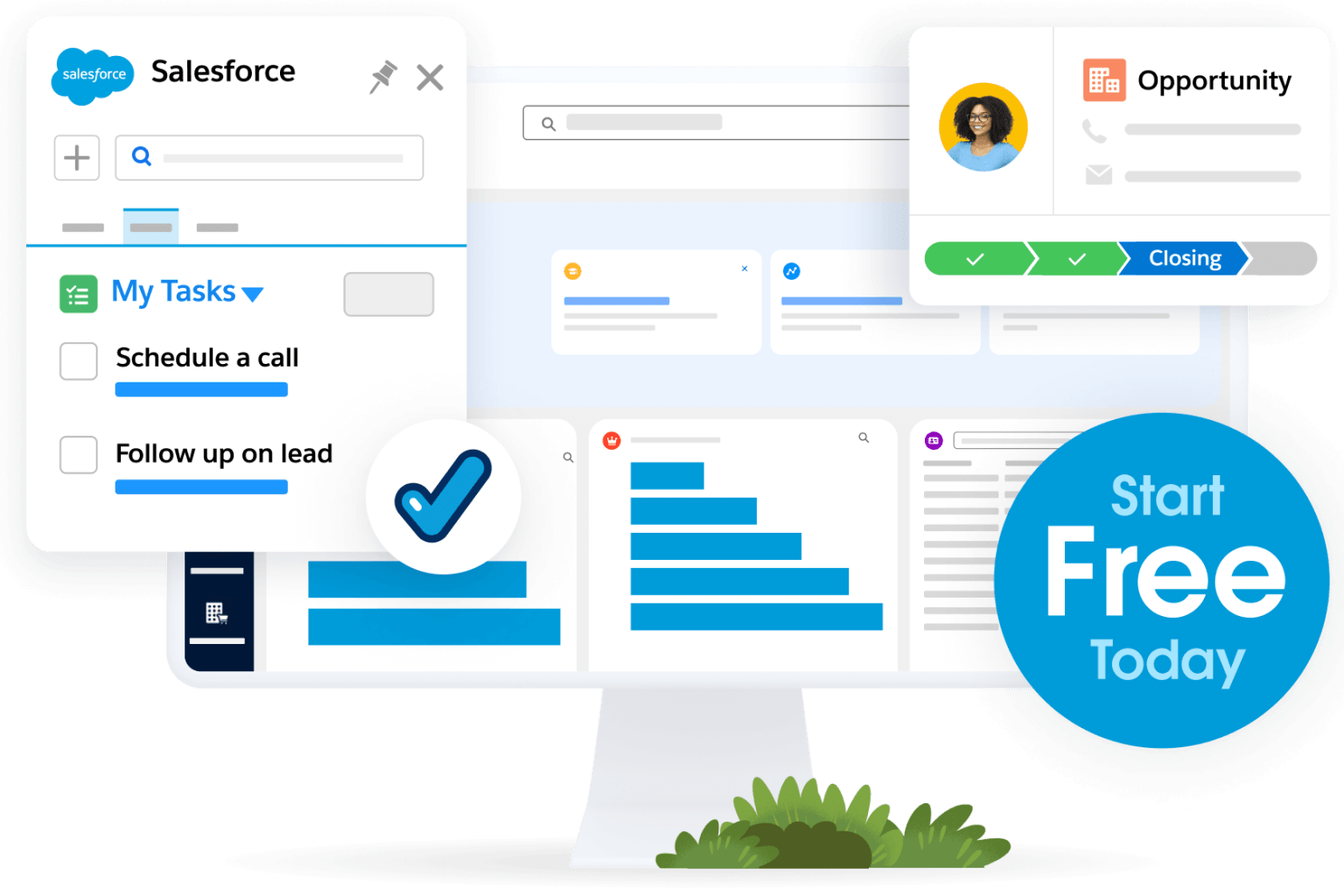
Get Salesforce’s free CRM — built for small business.
Stay organized, increase productivity, and move your business forward with our free CRM. No cost, no trial period, and no software to install.
Run task delegation like the pros
Successful task delegation hinges on knowing which repeatable tasks to hand off, choosing the right person for the job, and, most importantly, equipping them with the right tools. A CRM gives your team the data and context needed to execute delegated tasks with confidence. So, go for it.
Start your CRM journey with Free or Starter Suite today. Looking for more customization? Explore Pro Suite. Already a Salesforce customer? Activate Foundations to try out Agentforce 360 today.
AI supported the writers and editors who created this article.
What is task delegation?
Task delegation is the act of a leader assigning specific duties or responsibilities to a team member or employee, allowing the leader to focus on higher-level strategic work.
Why is task delegation important for small businesses?
For small businesses and startups, task delegation is essential for scaling, preventing founder burnout, empowering employees, and ensuring that strategic priorities do not get overlooked by routine operational demands.
What types of tasks should I delegate?
Generally, you should delegate tasks that are time-consuming, repeatable, administrative, or that don’t require your unique expertise, such as routine data entry in your CRM or initial customer service triage.
How can technology assist with task delegation?
Technology, like Agentforce 360 and a unified CRM platform, assists by providing a single source of truth for data, automating routine processes, and offering AI tools that empower employees to execute delegated tasks more efficiently.
What are the biggest barriers to successful task delegation?
Common barriers include a fear of loss of control, a lack of trust in employees’ abilities, or an unwillingness to take the time to properly train or communicate clear expectations for the delegated task.


