


An Employer of Record, or EOR, acts as the employer on paper, handling payroll, taxes, benefits administration, and local labor law compliance while letting you keep day-to-day control over the employee’s actual work. It’s one of the most practical ways to expand into new markets without the cost and complexity of setting up your own business entity in other countries.
Still, choosing the right provider takes more than checking who offers international hiring. The real differences show up in how each platform handles compliance, supports your team behind the scenes, and fits the way your company plans to grow.
To help you find the right one, I evaluated ten providers and narrowed the list down to my top five picks:
| Provider | ||
|---|---|---|
| Remote | ||
| Papaya Global | ||
| Deel | ||
| Multiplier | ||
| Oyster |
Learn more: What Is an Employer of Record?
Top employer of record services compared
The table below compares the best EOR services side by side, so you can quickly see how they stack up on country coverage and other key features.
| Provider | |||||
|---|---|---|---|---|---|
| Remote | |||||
| Papaya Global | |||||
| Deel | |||||
| Multiplier | |||||
| Oyster | |||||
| *depends on risk assessment | |||||
Why you can trust my advice
I’ve spent more than seven years evaluating and writing about HR software, including HR services, EOR solutions, and global payroll tools. I also have 10 years of experience handling human resources and HR systems. These allowed me to provide insights to help business owners determine which platform best fits their needs.
For this guide, I compared 10 employer of record services using a rubric with 37 data points. I looked at global workforce management features, compliance, payroll tools, country coverage, client support, pricing, and overall system performance. My recommendations are also based on vendor documentation and hands-on testing (when available) to reflect real business use.
See my full methodology below.
Remote: Best overall EOR

Expert score: 3.59 out of 5
Remote is a strong fit for businesses that want a more controlled approach to international hiring. Its EOR service covers the essentials, but what makes it stand out is the way it structures compliance through owned entities and built-in intellectual property (IP) protection. That makes it optimal for companies hiring in regulated markets or bringing on employees whose work involves sensitive intellectual property.
Why I chose Remote
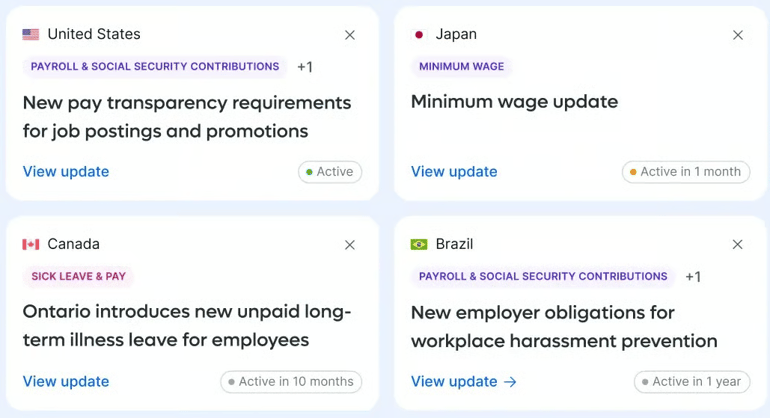
Remote’s employer of record platform covers the full employee lifecycle and includes core HR tools for managing onboarding/offboarding, legally-compliant contracts, benefits, PTO, and payroll. Unlike Papaya Global, Remote owns and operates 100% of its entities with no third-party handoffs, and it also backs that up with features like Remote IP Guard, unlimited indemnity coverage for EOR customers, and its Compliance Watchtower tool.
That gives HR teams more control in situations where compliance and IP protection are not negotiable. For companies hiring engineers or other employees creating valuable work products, fewer intermediaries can mean tighter oversight and a clearer line of accountability.
Pricing
Remote offers a wide range of global products and services. Some of the key solutions include:
- Employer of Record: $699/employee/mo.
- Payroll: $29/employee/mo.
- Contractor Management: $29/contractor/mo.
- Contractor Management Plus: $99/contractor/mo.
- Contractor of Record: Starts at $325/contractor/mo.
- Equity: Starts at $39/mo.
- Professional Employer Organization (PEO): Starts at $99/employee/mo., for US-based companies only
While the provider doesn’t charge setup fees for new EOR clients, it might require a refundable deposit. However, this is based on Remote’s risk assessment.
Features
- Built-in tools to amend contracts, generate employment letters, and process resignations in-platform
- Automated onboarding with localized contracts and payroll setup
- Country-specific onboarding, employee lifecycle tools, flexible benefits administration, and add-ons like background checks, equity solutions, immigration support, and expert consultations
- Compliance Watchtower for monitoring legal changes across 90+ countries
- IP Guard for intellectual property ownership documentation and protection across all operating countries
- Remote AI HR chatbot that provides personalized responses to HR questions based on country and employment type
Pros and cons
| Pros | Cons |
|---|---|
|
|
Papaya Global: Best for payroll and payments control

Expert score: 3.52 out of 5
While it can handle bulk employee hiring and onboarding, Papaya Global is the best EOR for businesses that need more oversight of payroll and workforce payments across countries. Similar to Remote, Deel, and Oyster, it also has a wide range of products, including solutions for global contractor management and a PEO service.
Why I chose Papaya Global
I’d use Papaya Global when the business is managing cross-border complexity that goes beyond standard hiring. Its appeal is less about being the cheapest or simplest and more about supporting varied workforce structures, stronger analytics, and enterprise-style controls.
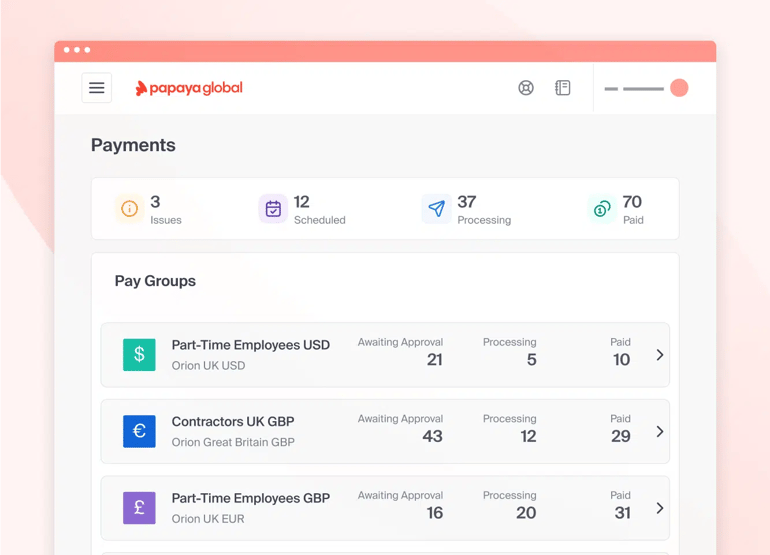
Unlike the other EORs on my list, Papaya owns its payment platform, which means there’s no need for third-party payment providers. This gives immediate oversight on the payout progress, removes the risk of hidden fees, and immediately alerts both employer and employee to any issues.
Pricing
Papaya Global lists clear pricing for most of its services covering EOR, contractors, and global workforce payments.
- Employer of Record: Starts at $499/employee/mo.
- Contractor of Record: Starts at $295/contractor/mo.
- Contractor solution: Starts at $5/contractor/mo.
- Payroll Plus: Starts at $29/employee/mo.
- Payment OS: Starts at $3.50/transaction
- Workforce OS: Call for a quote
- Contingent OS: Call for a quote
Features
- Automated onboarding, native HRIS, and a convenient employee self-service app
- Advanced analytics and reports for payroll, workforce data, and ERP, among others
- Guaranteed payment delivery in 72 hours or less
- AI-powered compliance monitoring with automatic adjustment to regulatory changes across jurisdictions
- Bulk onboarding for up to 1,000 employees
- Immigration services and time tracking included in the EOR package
Pros and cons
| Pros | Cons |
|---|---|
|
|
Deel: Best for fast-scaling global teams

Expert score: 3.50 out of 5
Deel is the strongest pick for companies that want broad EOR reach, a deep feature stack, and an efficient global employment platform. It supports legal employment in over 110 countries and bundles EOR with automated onboarding, payroll, tax filings, benefits enrollment, compliance, and on-demand HR support.
Why I chose Deel
Its EOR reach may not be as wide as Papaya Global’s (110+ vs 160+ countries), but Deel provides access to an integrated talent marketplace with AI tools to help you find candidates faster or pair up with its trusted recruitment partners. This makes it easy for your hiring team to fill open roles as you expand your workforce.
Similar to Remote and Papaya Global, Deel can handle the employee lifecycle with its core HR, benefits, and payroll tools. It also offers background checks, work visa support, contractor cards, and IT tools for managing company-assigned computers.
Pricing
Deel has one of the most extensive product offerings among the employer of record services that I reviewed. It has services for global and US workers, including tools for various HR functions, such as applicant tracking, benefits administration, and performance reviews. There are also modules for global mobility, visa support, and IT tools.
For EOR, Deel has two plans:
| Standard | Enterprise |
|---|---|
| Starts at $599/employee/mo. | Starts at $899/employee/mo. |
Features:
| Standard features plus:
|
Other key products include:
- Hire Contractors
- Standard: Starts at $49/contractor/mo.
- Contractor of Record: Starts at $325/contractor/mo.
- Hire US PEO Employees: Starts at $125/employee/mo.
- Deel IT
- Starter: $45/user/mo.
- Growth: $125/user/mo.
- Scale: $133/user/mo.
- Deel Mobility: Call for a quote; has three plans (Essential, Pro, and Managed)
- Visas: Call for a quote
Features
- AI-powered compliance monitoring with 200+ in-house legal experts providing human oversight
- Assistance with immigration, green cards, visas, and other documents
- Run background checks, rent out computer equipment, automate HR tasks, and integrate into other critical apps in your tech stack
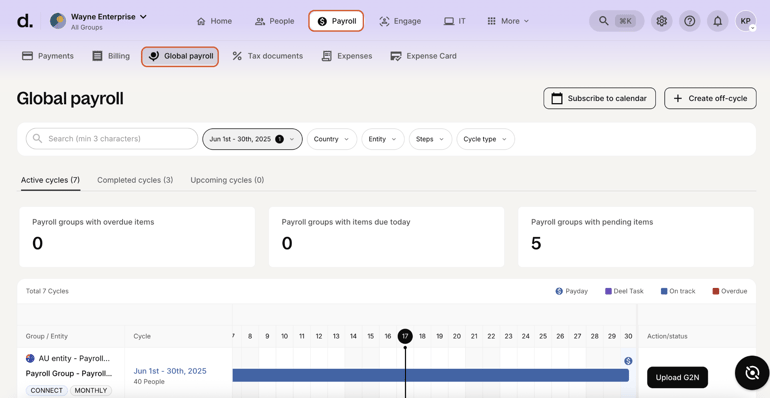
- Multiple payment options with real-time payroll for gross-to-net calculations
- Deel Card (physical and virtual) for contractor payments, a feature unique among the EOR providers in this
- Deel HR modules provide access to a wide range of talent management solutions, like performance reviews, learning, surveys, and salary insights
Pros and cons
| Pros | Cons |
|---|---|
|
|
Multiplier: Best for low-cost workforce expansion

Expert score: 3.42 out of 5
Multiplier is a great option if your goal is to hire in multiple countries, pay people correctly, and keep costs easier to forecast. It may not have all the bells and whistles that Deel or Remote offers, but its EOR platform has the core features you need to remain compliant and onboard employees quickly in over 150 countries — for a starter monthly fee of only $400 per employee.
Why I chose Multiplier
While not as customizable or broad in scope as the other employer of record services in this guide, Multiplier enables you to hire and pay staff across numerous borders without added work or risk. I like that it has an affordable starter fee and that it’s not trying to be everything at once, which is exactly why it works well for global-first hiring teams that want a practical EOR solution.
However, its value story is not just about price and platform simplicity. You also get compliant contracts in as little as five minutes, payroll in 100+ currencies, localized benefits, time off and expense tools, and headcount and cost center reporting. That makes Multiplier easier to justify for cost-conscious workforce expansion than providers like Papaya Global.
Pricing
- Employer of Record: Starts at $400/employee/mo.
- Contractors: Starts at $40/contractor/mo.
- Global payroll: Call for a quote
- Immigration: Call for a quote
Features
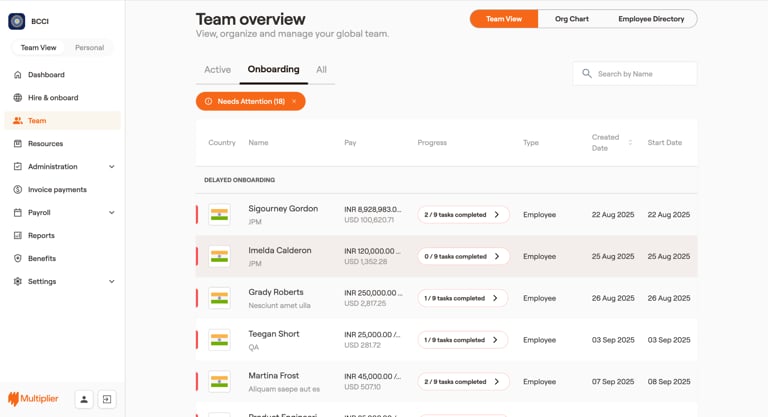
- Generates legally compliant contracts in just five minutes, with tracking tools to monitor onboarding milestones
- Multiple payment methods, from bank transfer to cryptocurrency payouts
- ESOP/equity distribution support across multiple regions — a unique feature not widely available at Multiplier’s EOR price point
- First-class automation to streamline HR workflows
- Access data-driven reports, including headcount, gross-to-net, and cost-center reporting
Pros and cons
| Pros | Cons |
|---|---|
|
|
Oyster: Best for employee benefits & total rewards

Expert score: 3.01 out of 5
Most employer of record services are designed from the employer’s vantage point: compliance efficiency, fast onboarding, and cost transparency. Oyster is built with equal attention to what the experience looks like for the employee on the receiving end. That focus shows up in features like Oyster Academy, a built-in employee learning and development platform, its salary insights tool, and in the depth of localized benefits it packages into its EOR plan.
Why I chose Oyster
Oyster’s EOR solution covers the basics, but it also puts more weight on how employers attract and retain talent. In addition to its learning tools, it bundles private health insurance, wellness stipends, maternity care, and mental health coverage into its standard benefits package across most markets.
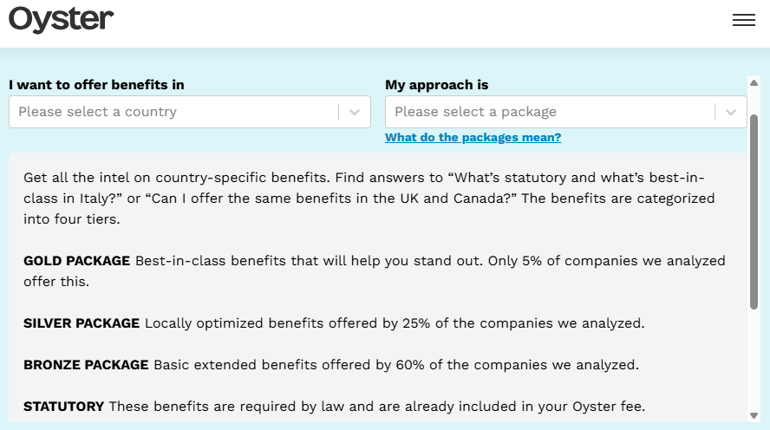
You even get a benefits insights tool to help you find best-in-class country-specific employee benefits that top-hiring companies offer. What’s great about this feature is that it categorizes the packages into statutory, bronze, silver, and gold levels, allowing you to determine the benefits that will make you stand out and are required by law.
Pricing
Oyster’s core products include:
- Employer of Record: $699/employee/mo.
- Global Contractors: $29/contractor/mo.
- Global Payroll: $29/employee/mo.
- US PEO: $114/employee/mo.
- People Partner Services: $300/hr; includes white-glove, project-based HR advisory services
Similar to Remote, it charges a refundable deposit for EOR employees. Oyster also offers custom-priced add-on solutions for benefits, visa sponsorship, salary insights, payment processing, and additional misclassification risk protection of up to $500,000.
While you can pay on a month-to-month basis, Oyster has an annual plan that lets you purchase EOR seats upfront at a locked, negotiated rate. This makes it a good option for companies that have high turnover rates or plan to expand to a larger team within a year.
For example, you pre-purchased 20 EOR seats for the year. You can fill these seats with existing employees and/or your planned new hires. If a seat becomes vacant due to a staff resignation, you can simply reuse it to hire a replacement.
Features
- EOR reach covers 110+ countries, with an operating model that’s a mix of owned entities and local partners
- Payroll processing in 120+ currencies with consolidated multi-country payroll in a single dashboard
- Automated expenses, time-off tracking, and reports
- Oyster Academy differentiates Oyster as a talent development platform, not just a compliance vehicle
- Oyster Shell add-on for its contractor plan provides additional worker misclassification risk protection, with an aggregate limit of $500,000
- Access to onboarding/offboarding specialists, visa support, and a benefits advisor tool, including salary insights to help you build a competitive compensation package
Pros and cons
| Pros | Cons |
|---|---|
|
|
How to choose the best EOR service?
The best EOR isn’t always the platform with the lowest monthly fee or the longest feature list. It’s the one that can handle the kind of global hiring complexity your team is dealing with right now and still work as your needs change.
When comparing providers, I’d focus on these factors:
- Compliance model: This should be the first filter. Look at how the provider handles legal employment, local labor law compliance, compliant contracts, payroll accuracy, and in-country expertise.
- Payroll and payments: If your team needs better visibility into payout timing, statutory payments, payroll reporting, or cross-border payment workflows, pay close attention here.
- Platform scope: Check how much of the employee lifecycle the platform can handle. Some EORs may only cover hiring, payroll, and compliance, while others may also support onboarding, offboarding, benefits, HR admin, background checks, and equipment or software management.
- Benefits and total rewards: If you are hiring in competitive markets, this matters more than many teams expect. Look at how well the provider supports local benefits, salary benchmarking, equity, and offer design across countries.
- Pricing clarity: Cost still matters, but only after you know the provider can do the job. What you want here is clear pricing, fewer surprises, and a service model that makes sense for your hiring volume and internal resources.
Start by narrowing your shortlist based on risk, operational fit, and hiring plans. Once you know which providers can actually support the way your team works, then you can compare pricing and platform extras.
Methodology: How I evaluated the top EORs
We looked at a wide range of EOR solutions to compile this list of the best software. We assessed different parameters for each software, including its usability, scalability, standout features and customer support. We also considered customer testimonials and ratings as vital components of our overall assessment of each software.
To build this list of the best employer of record services, I used a rubric with 37 data points to evaluate and compare these providers:
- Remote
- Deel
- Multiplier
- Oyster
- Papaya Global
- Rippling EOR
- Justworks EOR
- Gusto EOR
- Atlas HXM
- Pebl (formerly Velocity Global)
I scored each EOR on a scale of one to five across six criteria. To narrow the list to my top picks, I focused on features that businesses are most likely to need, such as local compliance tools, global payroll and hiring capabilities, and core HR functions to manage onboarding, offboarding, and employee information.
I also considered pricing, customer support, reporting, automations, and overall platform performance. Then, I added my expert score to each criterion based on the effectiveness and usefulness of the features offered.
Below is my full evaluation criteria:
- Country coverage & compliance (25%): Choosing an EOR starts with whether the provider can support compliant hiring in the countries where a business needs to employ workers. This area weighs both the breadth of country coverage and the legal infrastructure behind that coverage, including how clearly the provider explains its employment model.
- Global payroll (20%): Payroll is one of the most operationally critical parts of any EOR service. This area weighs how well each provider supports cross-border payroll operations with attention to payment flexibility, reporting, and common payroll-related admin needs.
- Pricing (15%): EOR pricing can be difficult to compare when vendors are vague about what is included or how contracts are structured. This area weighs how clearly each provider explains its fees, service scope, and commitment terms before a buyer signs on.
- Client support (15%): The best EOR providers do more than process employment tasks. This area weighs how well each vendor supports clients during implementation, day-to-day management, and international expansion.
- Workforce administration (15%): Hiring is only one part of managing an international workforce. This area weighs how well each provider supports the ongoing administrative side of employment, including benefits administration, leave management, and time tracking.
- Platform & integrations (10%): Software is not the main reason companies buy an EOR, but platform quality still affects efficiency, scalability, and day-to-day administration. This area weighs whether the platform offers the connectivity, automation, self-service tools, and security controls needed to support real HR and payroll operations.
Frequently asked questions (FAQs)
How long does it take to hire an employee through an EOR?
In many cases, hiring through an EOR takes about 48 hours to one week, though it can stretch longer if the country has stricter requirements or documents are delayed. The timeline also depends on the provider, contract review length, and local compliance checks.
Are employee benefits included in EOR pricing?
Not always. Some EOR providers include basic statutory benefits in their base fee, while others charge separately for enhanced or market-competitive benefits packages, so you need to look closely at what is required by law versus what counts as an added offering.
What costs should I watch for beyond the base EOR fee?
The monthly EOR fee is only part of the total cost. Depending on the provider, you may also pay for benefits upgrades, visa support, equity administration, payroll changes, setup fees, or other add-on services that are not included in the starting price.